Ch 25: Current, Resistance, and EMF
Young & Freedman Calc - University Physics 15th Edition
Young & Freedman Calc15th EditionUniversity PhysicsISBN: 9780135159552Not the one you use?Change textbook
Chapter 25, Problem 23b

What is the resistance of a carbon rod at 25.825.8°C if its resistance is 0.0160Ω0.0160 Ω at 0.00.0°C?

Verified step by step guidance
1
Identify the formula for resistance change with temperature: \( R = R_0 (1 + \alpha \Delta T) \), where \( R \) is the resistance at temperature \( T \), \( R_0 \) is the resistance at the reference temperature, \( \alpha \) is the temperature coefficient of resistance, and \( \Delta T \) is the change in temperature.
Determine the known values: \( R_0 = 0.0160 \; \Omega \) at \( 0.0^\circ C \), \( T = 25.8^\circ C \), and \( \Delta T = 25.8^\circ C - 0.0^\circ C = 25.8^\circ C \).
Look up the temperature coefficient of resistance for carbon, which is typically around \( \alpha = -0.0005 \; ^\circ C^{-1} \).
Substitute the known values into the formula: \( R = 0.0160 \; \Omega (1 + (-0.0005 \; ^\circ C^{-1}) \times 25.8^\circ C) \).
Simplify the expression to find the resistance \( R \) at \( 25.8^\circ C \).

Verified video answer for a similar problem:

This video solution was recommended by our tutors as helpful for the problem above.
Video duration:
2m
Was this helpful?

Key Concepts

Here are the essential concepts you must grasp in order to answer the question correctly.

Resistance

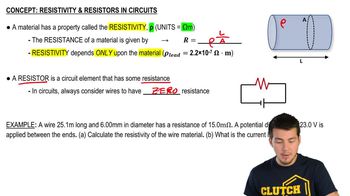
Resistance is a measure of the opposition to the flow of electric current through a conductor. It is influenced by the material's properties, length, and cross-sectional area. The unit of resistance is the ohm (Ω), and it plays a crucial role in determining how much current will flow for a given voltage according to Ohm's Law.
Recommended video:
Guided course
05:25
Resistivity & Resistors in Circuits

Temperature Coefficient of Resistance

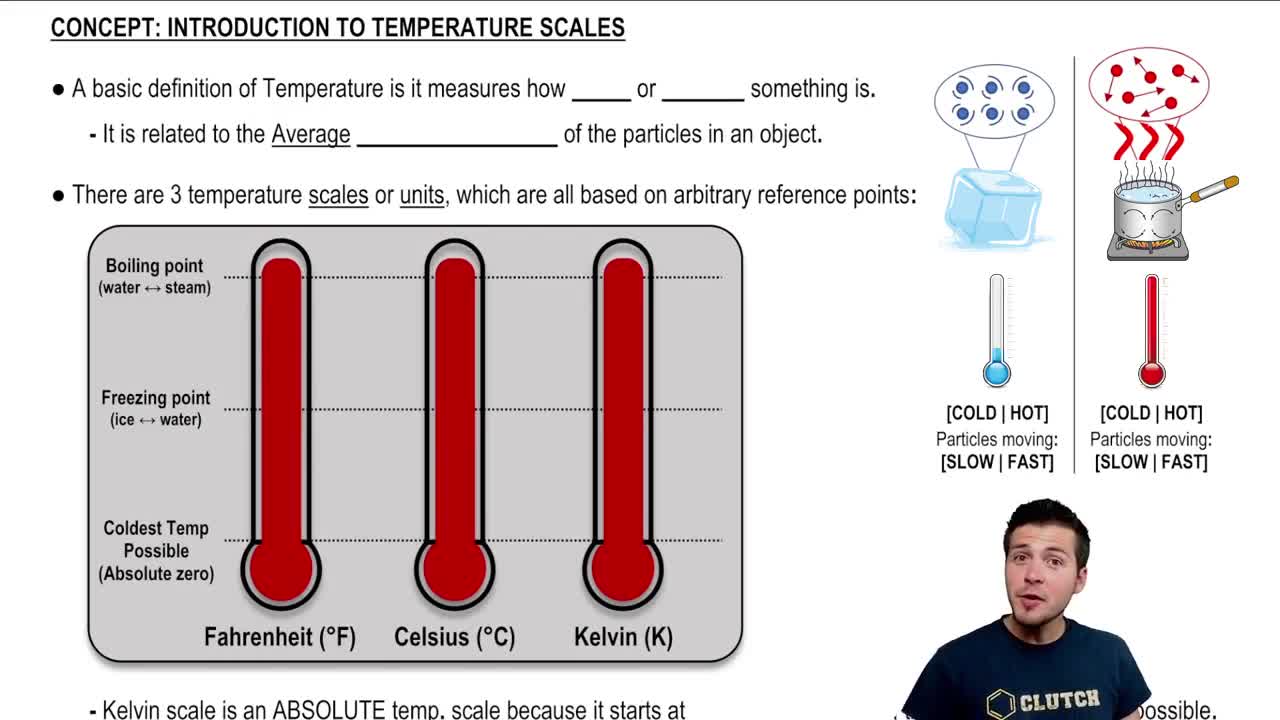
The temperature coefficient of resistance indicates how the resistance of a material changes with temperature. For most conductors, resistance increases with temperature. This coefficient is typically expressed in per degree Celsius (°C) and is used to calculate the change in resistance with temperature using the formula R = R0(1 + α(T - T0)), where α is the temperature coefficient.
Recommended video:
Guided course
04:54
Introduction To Temperature Scales

Linear Approximation in Resistance Change

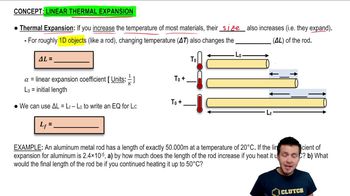
Linear approximation assumes that the change in resistance with temperature is linear over a small temperature range. This simplification allows us to use the temperature coefficient of resistance to estimate resistance at a new temperature, given the resistance at a reference temperature. This approach is valid for small temperature changes and materials with a relatively constant coefficient.
Recommended video:
Guided course
07:31
Linear Thermal Expansion