Ch 25: Current, Resistance, and EMF
Young & Freedman Calc - University Physics 15th Edition
Young & Freedman Calc15th EditionUniversity PhysicsISBN: 9780135159552Not the one you use?Change textbook
Chapter 25, Problem 18

A ductile metal wire has resistance RR. What will be the resistance of this wire in terms of RR if it is stretched to three times its original length, assuming that the density and resistivity of the material do not change when the wire is stretched? (Hint: The amount of metal does not change, so stretching out the wire will affect its cross-sectional area.)

Verified step by step guidance
1
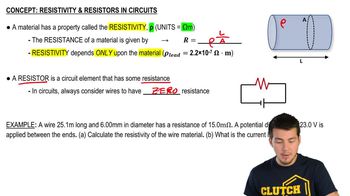
Understand that the resistance of a wire is given by the formula: R = ρ×LA, where ρ is the resistivity, L is the length, and A is the cross-sectional area.
Recognize that when the wire is stretched to three times its original length, the new length L' becomes 3L.
Since the volume of the wire remains constant, the original volume V = L×A is equal to the new volume V' = L'×A'. Therefore, L×A = 3L×A'.
Solve for the new cross-sectional area A': A' = A3.
Substitute the new length and area into the resistance formula: R' = ρ×L'A' = ρ×31×LA3. Simplify to find R' = 9R.

Verified video answer for a similar problem:

This video solution was recommended by our tutors as helpful for the problem above.
Video duration:
3m
Was this helpful?

Key Concepts

Here are the essential concepts you must grasp in order to answer the question correctly.

Resistance and Resistivity

Resistance (R) of a wire is determined by its resistivity (ρ), length (L), and cross-sectional area (A) using the formula R = ρL/A. Resistivity is a material property that remains constant for a given material, while resistance changes with the wire's dimensions. Understanding this relationship is crucial for analyzing how changes in length and area affect resistance.
Recommended video:
Guided course
05:25
Resistivity & Resistors in Circuits

Conservation of Volume

When a wire is stretched, its volume remains constant if the material's density does not change. This means that the product of the cross-sectional area (A) and length (L) before stretching equals the product after stretching. This principle helps determine how the cross-sectional area changes when the wire's length is altered.
Recommended video:
Guided course
05:21
Volume Thermal Expansion

Effect of Length on Resistance

Stretching a wire increases its length, which directly affects its resistance. Since resistance is proportional to length (R ∝ L), tripling the length of the wire will increase its resistance. However, the cross-sectional area decreases, which further impacts resistance, requiring a comprehensive understanding of how these factors interplay.
Recommended video:
Guided course
07:40
The Doppler Effect