Ch 16: Sound & Hearing
Young & Freedman Calc - University Physics 15th Edition
Young & Freedman Calc15th EditionUniversity PhysicsISBN: 9780135159552Not the one you use?Change textbook
Chapter 16, Problem 12

(a) By what factor must the sound intensity be increased to raise the sound intensity level by 13.0 dB? (b) Explain why you don't need to know the original sound intensity

Verified step by step guidance
1
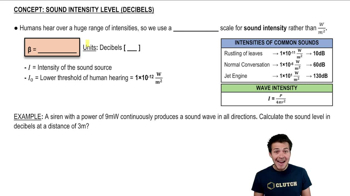
Step 1: Understand the relationship between sound intensity level (in decibels) and sound intensity. The sound intensity level in decibels is given by the formula: L=10logII0, where I is the sound intensity and I0 is the reference intensity.
Step 2: To find the factor by which the sound intensity must be increased, use the change in sound intensity level formula: ΔL=10logIfIi, where If is the final intensity and Ii is the initial intensity.
Step 3: Set ΔL to 13.0 dB and solve for the ratio IfIi. This gives: 13=10logIfIi.
Step 4: Rearrange the equation to solve for the intensity ratio: IfIi=101310. This expression gives the factor by which the intensity must be increased.
Step 5: For part (b), understand that the change in sound intensity level is independent of the original intensity because the decibel scale is logarithmic. The factor by which intensity changes depends only on the difference in decibels, not the initial value.

Verified video answer for a similar problem:

This video solution was recommended by our tutors as helpful for the problem above.
Video duration:
3m
Was this helpful?

Key Concepts

Here are the essential concepts you must grasp in order to answer the question correctly.

Sound Intensity Level

Sound intensity level, measured in decibels (dB), is a logarithmic scale that quantifies the intensity of sound relative to a reference level. It is calculated using the formula L = 10 log10(I/I0), where I is the sound intensity and I0 is the reference intensity, typically the threshold of hearing. This scale allows for easier comparison of sound intensities.
Recommended video:
Guided course
04:25
Sound Intensity Level and the Decibel Scale

Logarithmic Scale

A logarithmic scale is a nonlinear scale used for a large range of quantities. In the context of sound intensity, it means that each increase of 10 dB represents a tenfold increase in intensity. This property is crucial for understanding how changes in dB relate to changes in actual sound intensity, allowing for calculations without needing the original intensity value.
Recommended video:
Guided course
04:25
Sound Intensity Level and the Decibel Scale

Sound Intensity

Sound intensity refers to the power per unit area carried by a sound wave, typically measured in watts per square meter (W/m²). It is a physical quantity that describes the energy of sound waves passing through a given area, and is directly related to the perceived loudness of the sound. Understanding sound intensity is essential for calculating changes in sound intensity levels.
Recommended video:
Guided course
04:25
Sound Intensity Level and the Decibel Scale
Related Practice
Textbook Question

You are trying to overhear a juicy conversation, but from your distance of 15.0 m, it sounds like only an average whisper of 20.0 dB. How close should you move to the chatterboxes for the sound level to be 60.0 dB?

Textbook Question

You live on a busy street, but as a music lover, you want to reduce the traffic noise. If you install special soundreflecting windows that reduce the sound intensity level (in dB) by 30 dB, by what fraction have you lowered the sound intensity (in W/m2)?

Textbook Question

Sound is detected when a sound wave causes the tympanic membrane (the eardrum) to vibrate. Typically, the diameter of this membrane is about 8.4 mm in humans. How much energy is delivered to the eardrum each second when someone whispers (20 dB) a secret in your ear?

1
views
Textbook Question

An oscillator vibrating at 1250 Hz produces a sound wave that travels through an ideal gas at 325 m/s when the gas temperature is 22.0°C. For a certain experiment, you need to have the same oscillator produce sound of wavelength 28.5 cm in this gas. What should the gas temperature be to achieve this wavelength?

2
views
Textbook Question

Consider a sound wave in air that has displacement amplitude 0.0200 mm. Calculate the pressure amplitude for frequencies of (a) 150 Hz; (b) 1500 Hz; (c) 15,000 Hz. In each case compare the result to the pain threshold, which is 30 Pa.

3
views
Textbook Question

A sound wave in air at 20°C has a frequency of 320 Hz and a displacement amplitude of 5.00 × 10⁻³ mm. For this sound wave calculate the pressure amplitude (in Pa)

1
views