Ch 16: Sound & Hearing
Young & Freedman Calc - University Physics 15th Edition
Young & Freedman Calc15th EditionUniversity PhysicsISBN: 9780135159552Not the one you use?Change textbook
Chapter 16, Problem 16a

You live on a busy street, but as a music lover, you want to reduce the traffic noise. If you install special soundreflecting windows that reduce the sound intensity level (in dB) by 30 dB, by what fraction have you lowered the sound intensity (in W/m2)?

Verified step by step guidance
1
Understand the relationship between sound intensity level in decibels (dB) and sound intensity in watts per square meter (W/m²). The formula to convert sound intensity level to intensity is: \( L = 10 \log_{10} \left( \frac{I}{I_0} \right) \), where \( L \) is the sound level in dB, \( I \) is the sound intensity, and \( I_0 \) is the reference intensity, typically \( 10^{-12} \text{ W/m}^2 \).
Recognize that a reduction of 30 dB means the new sound intensity level \( L' = L - 30 \). This implies that the new intensity \( I' \) is related to the original intensity \( I \) by the equation: \( L' = 10 \log_{10} \left( \frac{I'}{I_0} \right) = L - 30 \).
Use the property of logarithms to express the change in intensity: \( 10 \log_{10} \left( \frac{I'}{I_0} \right) = 10 \log_{10} \left( \frac{I}{I_0} \right) - 30 \). This simplifies to \( \log_{10} \left( \frac{I'}{I_0} \right) = \log_{10} \left( \frac{I}{I_0} \right) - 3 \).
Solve for the fraction \( \frac{I'}{I} \) by using the property of logarithms: \( \log_{10} \left( \frac{I'}{I} \right) = -3 \). This implies \( \frac{I'}{I} = 10^{-3} \).
Conclude that the sound intensity has been reduced to \( \frac{1}{1000} \) of its original value, meaning the sound intensity is now 0.1% of what it was before the installation of the sound-reflecting windows.

Verified video answer for a similar problem:

This video solution was recommended by our tutors as helpful for the problem above.
Video duration:
2m
Was this helpful?

Key Concepts

Here are the essential concepts you must grasp in order to answer the question correctly.

Sound Intensity Level

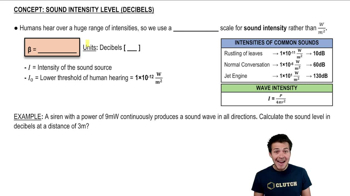
Sound intensity level, measured in decibels (dB), is a logarithmic scale that quantifies the intensity of sound waves. It is calculated using the formula: L = 10 * log10(I/I0), where I is the sound intensity and I0 is the reference intensity. A change in dB represents a multiplicative change in actual sound intensity.
Recommended video:
Guided course
04:25
Sound Intensity Level and the Decibel Scale

Decibel Scale

The decibel scale is a logarithmic scale used to measure sound intensity levels. A decrease of 10 dB corresponds to a tenfold reduction in sound intensity. Therefore, a reduction of 30 dB means the sound intensity is reduced by a factor of 1000, illustrating the non-linear nature of the scale.
Recommended video:
Guided course
04:25
Sound Intensity Level and the Decibel Scale

Sound Intensity

Sound intensity is the power per unit area carried by a sound wave, typically measured in watts per square meter (W/m²). It represents the energy transmitted by the wave and is directly related to the perceived loudness. Reducing sound intensity involves decreasing the energy transmitted, which can be achieved through soundproofing methods like special windows.
Recommended video:
Guided course
04:25
Sound Intensity Level and the Decibel Scale