
Ch 16: Sound & Hearing
Young & Freedman Calc - University Physics 15th Edition
Young & Freedman Calc15th EditionUniversity PhysicsISBN: 9780135159552Not the one you use?Change textbook
Chapter 16, Problem 3

Consider a sound wave in air that has displacement amplitude 0.0200 mm. Calculate the pressure amplitude for frequencies of (a) 150 Hz; (b) 1500 Hz; (c) 15,000 Hz. In each case compare the result to the pain threshold, which is 30 Pa.

Verified step by step guidance
1
Understand that the pressure amplitude of a sound wave is related to its displacement amplitude, frequency, and the properties of the medium (air in this case). The formula to calculate pressure amplitude (ΔP) is ΔP = ρvωs₀, where ρ is the air density, v is the speed of sound in air, ω is the angular frequency, and s₀ is the displacement amplitude.
Convert the displacement amplitude from millimeters to meters: s₀ = 0.0200 mm = 0.0200 × 10⁻³ m.
Calculate the angular frequency (ω) for each given frequency using the formula ω = 2πf, where f is the frequency. For example, for 150 Hz, ω = 2π × 150.
Use the known values for air density (ρ ≈ 1.21 kg/m³) and speed of sound in air (v ≈ 343 m/s) to calculate the pressure amplitude for each frequency using the formula ΔP = ρvωs₀.
Compare the calculated pressure amplitude for each frequency to the pain threshold of 30 Pa to determine if the sound wave exceeds this threshold.

Verified video answer for a similar problem:

This video solution was recommended by our tutors as helpful for the problem above.
Video duration:
7m
Was this helpful?

Key Concepts

Here are the essential concepts you must grasp in order to answer the question correctly.

Sound Waves

Sound waves are longitudinal waves that propagate through a medium, such as air, by compressions and rarefactions. The displacement amplitude refers to the maximum change in position of particles in the medium from their equilibrium position, which is crucial for determining the wave's intensity and pressure amplitude.
Recommended video:
Guided course
05:17
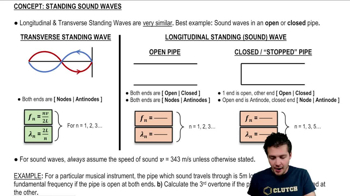
Standing Sound Waves

Pressure Amplitude

Pressure amplitude is the maximum change in pressure caused by a sound wave as it travels through a medium. It is directly related to the displacement amplitude and frequency of the wave, and is a key factor in determining the loudness of the sound. Calculating pressure amplitude involves understanding the relationship between these variables.
Recommended video:
Guided course
17:04
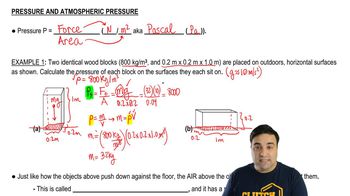
Pressure and Atmospheric Pressure

Frequency and Pain Threshold

Frequency refers to the number of oscillations or cycles per second of a sound wave, measured in Hertz (Hz). Different frequencies affect the pressure amplitude, which can be compared to the pain threshold of 30 Pa, the level at which sound becomes physically painful to humans. Understanding this comparison helps assess the potential impact of sound waves at various frequencies.
Recommended video:
Guided course
05:08
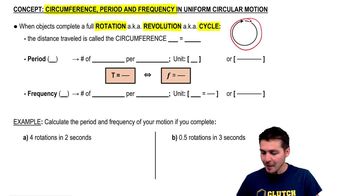
Circumference, Period, and Frequency in UCM
Related Practice
Textbook Question

Sound is detected when a sound wave causes the tympanic membrane (the eardrum) to vibrate. Typically, the diameter of this membrane is about 8.4 mm in humans. How much energy is delivered to the eardrum each second when someone whispers (20 dB) a secret in your ear?

1
views
Textbook Question

(a) By what factor must the sound intensity be increased to raise the sound intensity level by 13.0 dB? (b) Explain why you don't need to know the original sound intensity

1
views
Textbook Question

An oscillator vibrating at 1250 Hz produces a sound wave that travels through an ideal gas at 325 m/s when the gas temperature is 22.0°C. For a certain experiment, you need to have the same oscillator produce sound of wavelength 28.5 cm in this gas. What should the gas temperature be to achieve this wavelength?

2
views
Textbook Question

A loud factory machine produces sound having a displacement amplitude of 1.00 mm, but the frequency of this sound can be adjusted. In order to prevent ear damage to the workers, the maximum pressure amplitude of the sound waves is limited to 10.0 Pa. Under the conditions of this factory, the bulk modulus of air is 1.42 × 10⁵ Pa. What is the highest-frequency sound to which this machine can be adjusted without exceeding the prescribed limit? Is this frequency audible to the workers?

1
views
Textbook Question

Example 16.1 (Section 16.1) showed that for sound waves in air with frequency 1000 Hz, a displacement amplitude of 1.2 × 10⁻⁸ m produces a pressure amplitude of 3.0 × 10⁻² Pa. What is the wavelength of these waves?

2
views