Ch 11: Equilibrium & Elasticity
Young & Freedman Calc - University Physics 15th Edition
Young & Freedman Calc15th EditionUniversity PhysicsISBN: 9780135159552Not the one you use?Change textbook
Chapter 11, Problem 3

A uniform rod is 2.00 m long and has mass 1.80 kg. A 2.40 kg clamp is attached to the rod. How far should the center of gravity of the clamp be from the left-hand end of the rod in order for the center of gravity of the composite object to be 1.20 m from the left-hand end of the rod?

Verified step by step guidance
1
Identify the system: The system consists of a uniform rod and a clamp. The rod is 2.00 m long with a mass of 1.80 kg, and the clamp has a mass of 2.40 kg.
Understand the concept of center of gravity: The center of gravity of a system is the point where the total weight of the system can be considered to act. For a uniform rod, the center of gravity is at its midpoint, which is 1.00 m from either end.
Set up the equation for the center of gravity of the composite system: The center of gravity (CG) of the system is given by the formula: \( x_{CG} = \frac{m_1 x_1 + m_2 x_2}{m_1 + m_2} \), where \( m_1 \) and \( m_2 \) are the masses of the rod and clamp, and \( x_1 \) and \( x_2 \) are their respective distances from the reference point (left-hand end of the rod).
Substitute the known values into the equation: Here, \( m_1 = 1.80 \text{ kg} \), \( x_1 = 1.00 \text{ m} \), \( m_2 = 2.40 \text{ kg} \), and \( x_{CG} = 1.20 \text{ m} \). Substitute these into the equation to find \( x_2 \), the distance of the clamp's center of gravity from the left-hand end of the rod.
Solve the equation for \( x_2 \): Rearrange the equation to solve for \( x_2 \), which will give you the required distance of the clamp's center of gravity from the left-hand end of the rod.

Verified video answer for a similar problem:

This video solution was recommended by our tutors as helpful for the problem above.
Video duration:
5m
Was this helpful?

Key Concepts

Here are the essential concepts you must grasp in order to answer the question correctly.

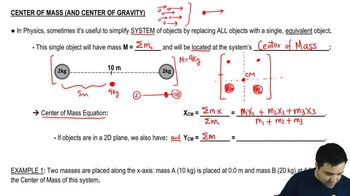
Center of Gravity

The center of gravity is the point where the total weight of a body or system is considered to be concentrated. For a uniform rod, it is located at its midpoint. When additional masses are attached, the center of gravity shifts towards the heavier mass, and its position can be calculated using the principle of moments.
Recommended video:
Guided course
14:02
Intro to Center of Mass

Principle of Moments

The principle of moments states that for a system to be in equilibrium, the sum of clockwise moments about any point must equal the sum of counterclockwise moments. This principle is used to find the new center of gravity by balancing the moments created by the rod and the attached clamp around a pivot point.
Recommended video:
Guided course
14:47
Diffraction with Huygen's Principle

Composite Object

A composite object is formed when two or more objects are combined, and its properties, such as mass and center of gravity, depend on the individual components. In this problem, the rod and clamp form a composite object, and the task is to determine the position of the clamp so that the center of gravity of the entire system is at a specified location.
Recommended video:
Guided course
07:47
Vector Composition & Decomposition