
Ch 11: Equilibrium & Elasticity
Young & Freedman Calc - University Physics 15th Edition
Young & Freedman Calc15th EditionUniversity PhysicsISBN: 9780135159552Not the one you use?Change textbook
Chapter 11, Problem 8

Two people are carrying a uniform wooden board that is 3.00 m long and weighs 160 N. If one person applies an upward force equal to 60 N at one end, at what point does the other person lift? Begin with a free-body diagram of the board.

Verified step by step guidance
1
Begin by drawing a free-body diagram of the board. Represent the board as a horizontal line. Mark the center of the board, which is the point where the weight of the board acts, as it is uniform. This point is 1.50 m from either end since the board is 3.00 m long.
Label the forces acting on the board in the diagram. The weight of the board, 160 N, acts downward at the center. One person applies an upward force of 60 N at one end of the board. Let the upward force applied by the other person be F, and it acts at a distance x from the center of the board.
Apply the principle of equilibrium. For the board to be in equilibrium, the sum of the vertical forces must be zero. Therefore, the equation is: 60 N + F = 160 N.
Next, apply the principle of rotational equilibrium. Choose the point where the 60 N force is applied as the pivot. The sum of the torques about this point must be zero. The torque due to the weight of the board is (160 N)(1.50 m), and it acts in the clockwise direction. The torque due to the force F is (F)(3.00 m - x), and it acts in the counterclockwise direction.
Set the sum of the torques equal to zero and solve for x: (160 N)(1.50 m) = F(3.00 m - x). Substitute F from the vertical force equilibrium equation into this torque equation to find the value of x, the point where the other person lifts the board.

Verified video answer for a similar problem:

This video solution was recommended by our tutors as helpful for the problem above.
Video duration:
5m
Was this helpful?

Key Concepts

Here are the essential concepts you must grasp in order to answer the question correctly.

Free-Body Diagram

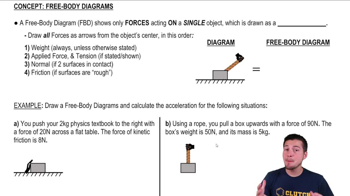
A free-body diagram is a graphical representation used to visualize the forces acting on an object. It helps in identifying all the forces, including gravitational, normal, and applied forces, acting on the object. In this problem, the diagram will show the weight of the board and the forces applied by the two people lifting it.
Recommended video:
Guided course
08:42
Free-Body Diagrams

Torque and Equilibrium

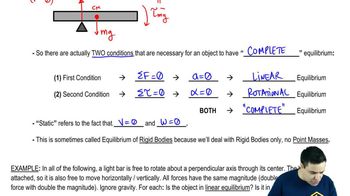
Torque is the rotational equivalent of force, calculated as the product of force and the distance from the pivot point. For an object in equilibrium, the sum of torques around any point is zero. In this scenario, setting the torques around the point where the second person lifts to zero will help determine the position where the board is balanced.
Recommended video:
Guided course
10:13
Torque & Equilibrium

Center of Gravity

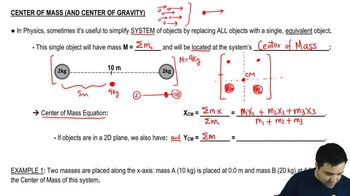
The center of gravity is the point where the total weight of a body is considered to be concentrated. For a uniform object, it is located at its geometric center. In this problem, the center of gravity of the board is at its midpoint, which is crucial for calculating the torques and determining the lifting point for the second person.
Recommended video:
Guided course
14:02
Intro to Center of Mass
Related Practice
Textbook Question

A uniform ladder 5.0 m long rests against a frictionless, vertical wall with its lower end 3.0 m from the wall. The ladder weighs 160 N. The coefficient of static friction between the foot of the ladder and the ground is 0.40. A man weighing 740 N climbs slowly up the ladder. Start by drawing a free-body diagram of the ladder. What is the maximum friction force that the ground can exert on the ladder at its lower end?

2
views
Textbook Question

A uniform 300-N trapdoor in a floor is hinged at one side. Find the net upward force needed to begin to open it and the total force exerted on the door by the hinges if the upward force is applied at the center.

3
views
Textbook Question

Two people carry a heavy electric motor by placing it on a light board 2.00 m long. One person lifts at one end with a force of 400 N, and the other lifts the opposite end with a force of 600 N. What is the weight of the motor, and where along the board is its center of gravity located?

2
views
Textbook Question

A uniform rod is 2.00 m long and has mass 1.80 kg. A 2.40 kg clamp is attached to the rod. How far should the center of gravity of the clamp be from the left-hand end of the rod in order for the center of gravity of the composite object to be 1.20 m from the left-hand end of the rod?

2
views
Textbook Question

A 350-N, uniform, 1.50-m bar is suspended horizontally by two vertical cables at each end. Cable A can support a maximum tension of 500.0 N without breaking, and cable B can support up to 400.0 N. You want to place a small weight on this bar. (a) What is the heaviest weight you can put on without breaking either cable, and (b) where should you put this weight?

1
views
Textbook Question

A uniform 300-N trapdoor in a floor is hinged at one side. Find the net upward force needed to begin to open it and the total force exerted on the door by the hinges if the upward force is applied at the center of the edge opposite the hinges.

10
views