Ch 11: Equilibrium & Elasticity
Young & Freedman Calc - University Physics 15th Edition
Young & Freedman Calc15th EditionUniversity PhysicsISBN: 9780135159552Not the one you use?Change textbook
Chapter 11, Problem 1

A 0.120-kg, 50.0-cm-long uniform bar has a small 0.055-kg mass glued to its left end and a small 0.110-kg mass glued to the other end. The two small masses can each be treated as point masses. You want to balance this system horizontally on a fulcrum placed just under its center of gravity. How far from the left end should the fulcrum be placed?

Verified step by step guidance
1
First, identify the components of the system: the uniform bar and the two point masses. The bar has a mass of 0.120 kg and a length of 50.0 cm, while the point masses are 0.055 kg and 0.110 kg located at the left and right ends, respectively.
Calculate the center of mass of the uniform bar. Since the bar is uniform, its center of mass is at its midpoint. Therefore, the center of mass of the bar is at 25.0 cm from the left end.
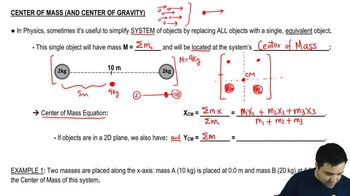
Determine the position of the center of mass for the entire system. Use the formula for the center of mass: x=miximi, where mi is the mass and xi is the position of each component.
Substitute the values into the center of mass formula: x=(0.055×0)+(0.120×25.0)+(0.110×50.0)0.055+0.120+0.110. This will give you the position of the center of mass of the system.
Finally, calculate the distance from the left end to the center of mass using the result from the previous step. This distance is where the fulcrum should be placed to balance the system horizontally.

Verified video answer for a similar problem:

This video solution was recommended by our tutors as helpful for the problem above.
Video duration:
6m
Was this helpful?

Key Concepts

Here are the essential concepts you must grasp in order to answer the question correctly.

Center of Gravity

The center of gravity is the point where the total weight of a system is considered to act. For a uniform bar with additional masses, it is calculated by finding the weighted average of the positions of all masses, including the bar itself. This concept is crucial for determining the balance point of the system.
Recommended video:
Guided course
14:02
Intro to Center of Mass

Torque

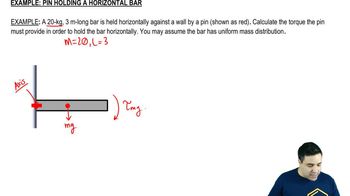
Torque is the rotational equivalent of force, calculated as the product of force and the distance from the pivot point. In this problem, balancing the system requires that the torques produced by the masses on either side of the fulcrum are equal, ensuring rotational equilibrium.
Recommended video:
Guided course
08:55
Net Torque & Sign of Torque

Uniform Bar

A uniform bar has a constant mass distribution along its length, meaning its center of gravity is at its geometric center. Understanding this helps in calculating the overall center of gravity of the system, as the bar's mass contributes to the total torque and affects the fulcrum's placement.
Recommended video:
Guided course
02:33
Pin holding a horizontal bar