A thin, rectangular sheet of metal has mass M and sides of length a and b. Use the parallel-axis theorem to calculate the moment of inertia of the sheet for an axis that is perpendicular to the plane of the sheet and that passes through one corner of the sheet.
Find the moment of inertia of a hoop (a thin-walled, hollow ring) with mass M and radius R about an axis perpendicular to the hoop's plane at an edge.
Verified step by step guidance
Verified video answer for a similar problem:
Key Concepts
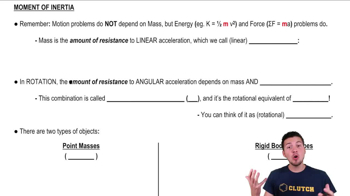
Moment of Inertia
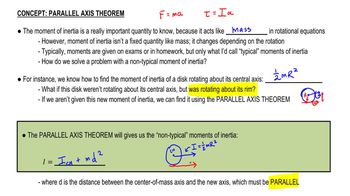
Parallel Axis Theorem
Geometry of the Hoop
A thin uniform rod of mass M and length L is bent at its center so that the two segments are now perpendicular to each other. Find its moment of inertia about an axis perpendicular to its plane and passing through the point where the two segments meet.
A uniform sphere with mass kg and radius m is rotating at constant angular velocity about a stationary axis that lies along a diameter of the sphere. If the kinetic energy of the sphere is J, what is the tangential velocity of a point on the rim of the sphere?
A wheel is turning about an axis through its center with constant angular acceleration. Starting from rest, at t = 0, the wheel turns through 8.20 revolutions in 12.0 s. At t = 12.0 s the kinetic energy of the wheel is 36.0 J. For an axis through its center, what is the moment of inertia of the wheel?
A slender rod with length L has a mass per unit length that varies with distance from the left end, where x = 0, according to dm/dx = γx, where γ has units of kg/m2. Use Eq. (9.20) to calculate the moment of inertia of the rod for an axis at the left end, perpendicular to the rod. Use the expression you derived in part (a) to express I in terms of M and L. How does your result compare to that for a uniform rod? Explain.
An airplane propeller is 2.08 m in length (from tip to tip) with mass 117 kg and is rotating at 2400 rpm (rev/min) about an axis through its center. You can model the propeller as a slender rod.
(a) What is its rotational kinetic energy?
(b) Suppose that, due to weight constraints, you had to reduce the propeller's mass to 75.0% of its original mass, but you still needed to keep the same size and kinetic energy. What would its angular speed have to be, in rpm?
