
Ch 09: Rotation of Rigid Bodies
Young & Freedman Calc - University Physics 15th Edition
Young & Freedman Calc15th EditionUniversity PhysicsISBN: 9780135159552Not the one you use?Change textbook
Chapter 9, Problem 53

A thin, rectangular sheet of metal has mass M and sides of length a and b. Use the parallel-axis theorem to calculate the moment of inertia of the sheet for an axis that is perpendicular to the plane of the sheet and that passes through one corner of the sheet.

Verified step by step guidance
1
Start by recalling the formula for the moment of inertia of a rectangular sheet about an axis perpendicular to its plane and passing through its center of mass. This is given by \( I_{\text{cm}} = \frac{1}{12} M (a^2 + b^2) \), where \( M \) is the mass of the sheet, and \( a \) and \( b \) are the lengths of its sides.
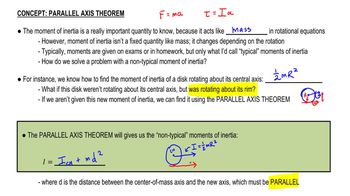
Next, recall the parallel-axis theorem, which states that the moment of inertia about any axis parallel to the center of mass axis is given by \( I = I_{\text{cm}} + M d^2 \), where \( d \) is the perpendicular distance between the two axes.
In this problem, the axis of rotation passes through one corner of the sheet. The distance \( d \) between the center of mass and this corner is the diagonal of the rectangle divided by 2. Using the Pythagorean theorem, the diagonal is \( \sqrt{a^2 + b^2} \), so \( d = \frac{1}{2} \sqrt{a^2 + b^2} \).
Substitute \( d \) into the parallel-axis theorem formula: \( I = \frac{1}{12} M (a^2 + b^2) + M \left( \frac{1}{2} \sqrt{a^2 + b^2} \right)^2 \).
Simplify the expression by squaring \( \frac{1}{2} \sqrt{a^2 + b^2} \) to get \( \frac{1}{4} (a^2 + b^2) \), and combine terms to find the total moment of inertia \( I \).

Verified video answer for a similar problem:

This video solution was recommended by our tutors as helpful for the problem above.
Video duration:
3m
Was this helpful?

Key Concepts

Here are the essential concepts you must grasp in order to answer the question correctly.

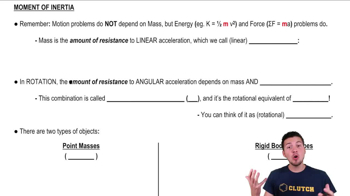
Moment of Inertia

Moment of inertia is a measure of an object's resistance to rotational motion about an axis. It depends on the mass distribution relative to the axis of rotation. For a thin rectangular sheet, the moment of inertia can be calculated using specific formulas that account for its shape and mass.
Recommended video:
Guided course
11:47
Intro to Moment of Inertia

Parallel-Axis Theorem

The parallel-axis theorem states that the moment of inertia of a body about any axis parallel to an axis through its center of mass can be found by adding the product of the mass and the square of the distance between the two axes to the moment of inertia about the center of mass axis. This theorem is essential for calculating the moment of inertia when the axis of rotation does not pass through the center of mass.
Recommended video:
Guided course
13:46
Parallel Axis Theorem

Rectangular Sheet Properties

A thin rectangular sheet has specific geometric properties that influence its moment of inertia. The dimensions (length a and width b) and mass M are critical in determining how the mass is distributed across the sheet. Understanding these properties allows for the application of the moment of inertia formulas relevant to rectangular shapes.
Recommended video:
Guided course
08:45
Properties of Cyclic Thermodynamic Processes
Related Practice
Textbook Question

A thin uniform rod of mass M and length L is bent at its center so that the two segments are now perpendicular to each other. Find its moment of inertia about an axis perpendicular to its plane and passing through the point where the two segments meet.

2
views
Textbook Question

A uniform sphere with mass 28.028.0 kg and radius 0.3800.380 m is rotating at constant angular velocity about a stationary axis that lies along a diameter of the sphere. If the kinetic energy of the sphere is 236236 J, what is the tangential velocity of a point on the rim of the sphere?

1
views
Textbook Question

A wheel is turning about an axis through its center with constant angular acceleration. Starting from rest, at t = 0, the wheel turns through 8.20 revolutions in 12.0 s. At t = 12.0 s the kinetic energy of the wheel is 36.0 J. For an axis through its center, what is the moment of inertia of the wheel?

1
views
Textbook Question

A slender rod with length L has a mass per unit length that varies with distance from the left end, where x = 0, according to dm/dx = γx, where γ has units of kg/m2. Use Eq. (9.20) to calculate the moment of inertia of the rod for an axis at the left end, perpendicular to the rod. Use the expression you derived in part (a) to express I in terms of M and L. How does your result compare to that for a uniform rod? Explain.

2
views
Textbook Question

Find the moment of inertia of a hoop (a thin-walled, hollow ring) with mass M and radius R about an axis perpendicular to the hoop's plane at an edge.

3
views