Ch 09: Rotation of Rigid Bodies
Young & Freedman Calc - University Physics 15th Edition
Young & Freedman Calc15th EditionUniversity PhysicsISBN: 9780135159552Not the one you use?Change textbook
Chapter 9, Problem 57b

A slender rod with length L has a mass per unit length that varies with distance from the left end, where x = 0, according to dm/dx = γx, where γ has units of kg/m2. Use Eq. (9.20) to calculate the moment of inertia of the rod for an axis at the left end, perpendicular to the rod. Use the expression you derived in part (a) to express I in terms of M and L. How does your result compare to that for a uniform rod? Explain.

Verified step by step guidance
1
Start by understanding the problem: The rod has a non-uniform mass distribution, where the mass per unit length is given by \( \frac{dm}{dx} = g x \). The goal is to calculate the moment of inertia \( I \) about an axis at the left end (\( x = 0 \)) using the given mass distribution and express \( I \) in terms of the total mass \( M \) and length \( L \).
The moment of inertia for a continuous mass distribution is given by \( I = \int r^2 \, dm \), where \( r \) is the distance from the axis of rotation and \( dm \) is the mass element. Here, \( r = x \), so \( I = \int_0^L x^2 \, dm \).
Substitute \( dm = \frac{dm}{dx} dx = g x \, dx \) into the integral. This gives \( I = \int_0^L x^2 (g x) \, dx = g \int_0^L x^3 \, dx \).
Evaluate the integral \( \int_0^L x^3 \, dx \). The result is \( \frac{x^4}{4} \) evaluated from 0 to \( L \), so \( \int_0^L x^3 \, dx = \frac{L^4}{4} \). Substituting this back, \( I = g \frac{L^4}{4} \).
Relate \( g \) to the total mass \( M \). The total mass is \( M = \int_0^L dm = \int_0^L g x \, dx = g \int_0^L x \, dx = g \frac{L^2}{2} \). Solving for \( g \), \( g = \frac{2M}{L^2} \). Substitute this into the expression for \( I \): \( I = \frac{2M}{L^2} \frac{L^4}{4} = \frac{1}{2} M L^2 \). Compare this result to the moment of inertia of a uniform rod, which is \( \frac{1}{3} M L^2 \). The non-uniform rod has a larger moment of inertia because more mass is distributed farther from the axis of rotation.

Verified video answer for a similar problem:

This video solution was recommended by our tutors as helpful for the problem above.
Video duration:
5m
Was this helpful?

Key Concepts

Here are the essential concepts you must grasp in order to answer the question correctly.

Moment of Inertia

Moment of inertia is a measure of an object's resistance to rotational motion about an axis. It depends on the mass distribution relative to the axis of rotation. For a slender rod, the moment of inertia can be calculated using the integral of the mass elements multiplied by the square of their distance from the axis. This concept is crucial for understanding how different mass distributions affect rotational dynamics.
Recommended video:
Guided course
11:47
Intro to Moment of Inertia

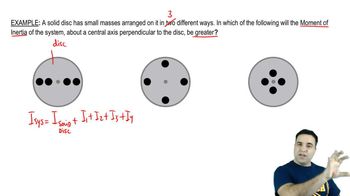
Variable Mass Distribution

Variable mass distribution refers to a situation where the mass per unit length of an object changes along its length. In this case, the mass per unit length of the rod varies according to the function dm/dx = gx, indicating that the mass increases with distance from one end. This affects the calculation of the moment of inertia, as each segment of the rod contributes differently based on its position and mass.
Recommended video:
Guided course
03:42
Moment of Inertia & Mass Distribution

Comparison with Uniform Rod

A uniform rod has a constant mass per unit length, leading to a straightforward calculation of its moment of inertia. In contrast, the slender rod in this problem has a varying mass distribution, which typically results in a different moment of inertia value. Comparing the results helps illustrate how mass distribution influences rotational properties, highlighting the significance of understanding both uniform and non-uniform cases in physics.
Recommended video:
Guided course
11:45
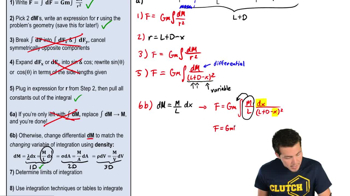
Gravitational Force of Rod Parallel to Axis