
Ch 05: Applying Newton's Laws
Young & Freedman Calc - University Physics 15th Edition
Young & Freedman Calc15th EditionUniversity PhysicsISBN: 9780135159552Not the one you use?Change textbook
Chapter 5, Problem 5a

A picture frame hung against a wall is suspended by two wires attached to its upper corners. If the two wires make the same angle with the vertical, what must this angle be if the tension in each wire is equal to 0.750.75 of the weight of the frame? (Ignore any friction between the wall and the picture frame.)

Verified step by step guidance
1
Step 1: Begin by identifying the forces acting on the picture frame. The weight of the frame (W) acts vertically downward, and the tension in each wire (T) acts along the direction of the wires. The wires make an angle θ with the vertical, and the tension in each wire is given as 0.75W.
Step 2: Resolve the tension forces into their vertical and horizontal components. The vertical component of the tension in each wire is T * cos(θ), and the horizontal component is T * sin(θ). Since there are two wires, the total vertical force is 2 * T * cos(θ), and the total horizontal force is 2 * T * sin(θ).
Step 3: Apply the condition for equilibrium. Vertically, the total upward force must balance the downward weight of the frame: 2 * T * cos(θ) = W. Horizontally, the forces must cancel out, so the horizontal components of the tension forces are equal and opposite, ensuring no net horizontal force.
Step 4: Substitute the given value of T = 0.75W into the vertical equilibrium equation: 2 * (0.75W) * cos(θ) = W. Simplify this equation to find cos(θ): cos(θ) = 1 / (2 * 0.75).
Step 5: Solve for θ using the relationship cos(θ) = adjacent/hypotenuse. Take the inverse cosine (arccos) of the value obtained for cos(θ) to determine the angle θ. This will give the angle each wire makes with the vertical.

Verified video answer for a similar problem:

This video solution was recommended by our tutors as helpful for the problem above.
Was this helpful?

Key Concepts

Here are the essential concepts you must grasp in order to answer the question correctly.

Tension in Wires

Tension is the force exerted along a wire or rope when it is pulled tight by forces acting from opposite ends. In this scenario, the tension in each wire must balance the weight of the picture frame, which is the force due to gravity acting on it. Understanding how tension works is crucial for analyzing the forces acting on the frame.
Recommended video:
Guided course
09:57
Magnetic Force on Current-Carrying Wire

Equilibrium of Forces

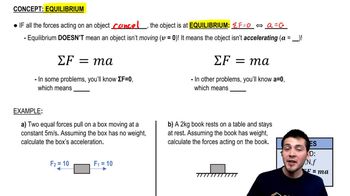
An object is in equilibrium when the net force acting on it is zero. For the picture frame, this means that the vertical components of the tension in the wires must equal the weight of the frame, while the horizontal components must cancel each other out. This concept is essential for determining the angles at which the wires are positioned.
Recommended video:

Trigonometric Relationships

Trigonometric functions relate the angles of a triangle to the lengths of its sides. In this problem, the angles formed by the wires with the vertical can be analyzed using sine and cosine functions. These relationships help in calculating the components of the tension forces and are vital for solving for the angle when given the ratio of tension to weight.
Recommended video:
Guided course
3:26
Trigonometry