Ch 05: Applying Newton's Laws
Young & Freedman Calc - University Physics 15th Edition
Young & Freedman Calc15th EditionUniversity PhysicsISBN: 9780135159552Not the one you use?Change textbook
Chapter 5, Problem 3b

A 75.075.0-kg wrecking ball hangs from a uniform, heavy-duty chain of mass 26.026.0 kg. What is the tension at a point three-fourths of the way up from the bottom of the chain?

Verified step by step guidance
1
Identify the forces acting on the chain and the wrecking ball. The tension at any point in the chain must support the weight of the wrecking ball and the portion of the chain below that point. Use the concept of distributed weight for the chain and treat the wrecking ball as a point mass.
Calculate the total weight of the wrecking ball using the formula: W=mg, where m is the mass of the wrecking ball (75.0 kg) and g is the acceleration due to gravity (9.8 m/s²).
Determine the weight of the chain below the point three-fourths of the way up. The chain has a total mass of 26.0 kg, so the mass of the chain below this point is one-fourth of the total chain mass. Use the formula: W=mg, where m is the mass of the chain below the point.
Add the weight of the wrecking ball and the weight of the chain below the point to find the total force that the tension must support at this location. Use the formula: T=Wball+Wchain.
Substitute the known values into the equations and simplify to find the tension at the specified point. Ensure that the units are consistent throughout the calculation.

Verified video answer for a similar problem:

This video solution was recommended by our tutors as helpful for the problem above.
Was this helpful?

Key Concepts

Here are the essential concepts you must grasp in order to answer the question correctly.

Tension in a Chain

Tension is the force exerted along the length of a chain or rope when it is subjected to a load. In this scenario, the tension varies along the chain due to the weight of the chain itself and the wrecking ball. The tension at any point in the chain can be calculated by considering the weight of the chain below that point and any additional loads acting on it.
Recommended video:
Guided course
06:34
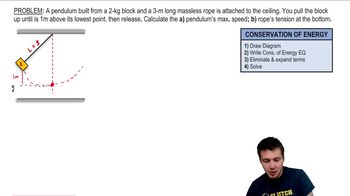
Calculating Tension in a Pendulum with Energy Conservation

Weight and Mass

Weight is the force exerted by gravity on an object, calculated as the product of its mass and the acceleration due to gravity (approximately 9.81 m/s² on Earth). In this problem, both the wrecking ball and the chain have mass, and their combined weight contributes to the tension experienced at different points in the chain.
Recommended video:
Guided course
10:19
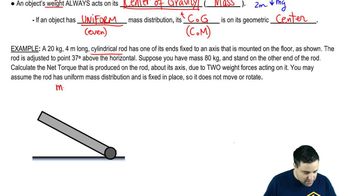
Torque Due to Weight

Static Equilibrium

Static equilibrium occurs when an object is at rest and the sum of all forces acting on it is zero. In this context, the wrecking ball and the chain are in static equilibrium, meaning the upward tension forces must balance the downward gravitational forces. Understanding this principle is crucial for analyzing the forces at play in the system.
Recommended video:
Guided course
08:11
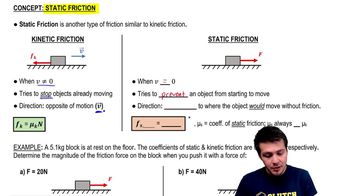
Static Friction & Equilibrium