
A man pushes on a piano with mass kg; it slides at constant velocity down a ramp that is inclined at above the horizontal floor. Neglect any friction acting on the piano. Calculate the magnitude of the force applied by the man if he pushes parallel to the incline.
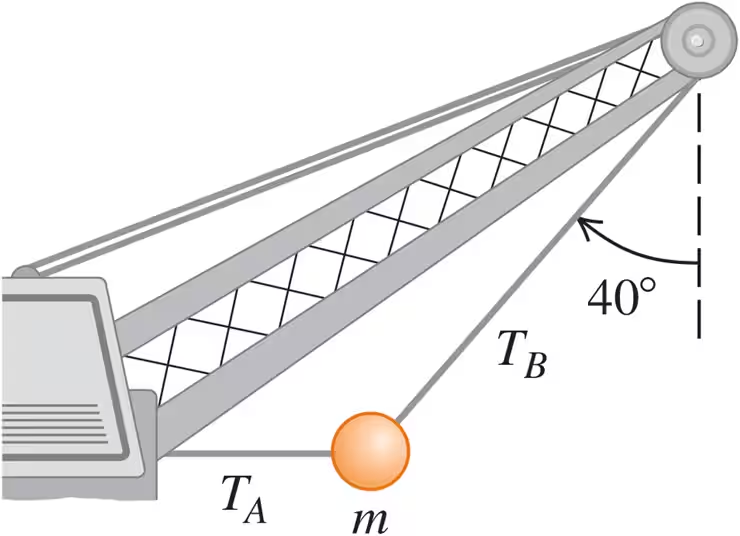
A large wrecking ball is held in place by two light steel cables (Fig. E). If the mass m of the wrecking ball is kg, what are the (a) tension in the cable that makes an angle of with the vertical and (b) the tension in the horizontal cable?

Verified step by step guidance
Verified video answer for a similar problem:
Key Concepts
Tension in Cables
Equilibrium of Forces
Trigonometric Functions
A man pushes on a piano with mass kg; it slides at constant velocity down a ramp that is inclined at above the horizontal floor. Neglect any friction acting on the piano. Calculate the magnitude of the force applied by the man if he pushes parallel to the floor.
Two -N weights are suspended at opposite ends of a rope that passes over a light, frictionless pulley. The pulley is attached to a chain from the ceiling. What is the tension in the chain?
Find the tension in each cord in Fig. E if the weight of the suspended object is .
A picture frame hung against a wall is suspended by two wires attached to its upper corners. If the two wires make the same angle with the vertical, what must this angle be if the tension in each wire is equal to of the weight of the frame? (Ignore any friction between the wall and the picture frame.)
A -kg wrecking ball hangs from a uniform, heavy-duty chain of mass kg. What is the tension at a point three-fourths of the way up from the bottom of the chain?
