
Ch 02: Motion Along a Straight Line
Young & Freedman Calc - University Physics 15th Edition
Young & Freedman Calc15th EditionUniversity PhysicsISBN: 9780135159552Not the one you use?Change textbook
Chapter 2, Problem 26d

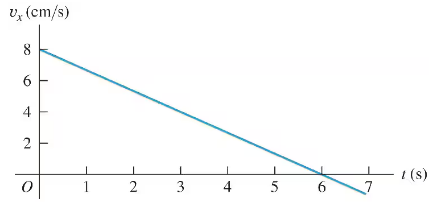
A cat walks in a straight line, which we shall call the xx-axis, with the positive direction to the right. As an observant physicist, you make measurements of this cat's motion and construct a graph of the feline's velocity as a function of time (Fig. E2.302.30). Assuming that the cat started at the origin, sketch clear graphs of the cat's acceleration and position as functions of time.
Velocity-time graph showing a linear decrease from 8 cm/s at 0s to 0 cm/s at 6s, continuing to -2 cm/s at 7s.

Verified step by step guidance
1
Examine the velocity-time graph provided. The graph shows a linear relationship between velocity and time, indicating that the cat's velocity changes at a constant rate. This suggests that the cat is experiencing constant acceleration.
To sketch the acceleration-time graph, note that acceleration is the rate of change of velocity with respect to time. Since the velocity graph is a straight line, the slope of this line represents the acceleration. Calculate the slope by taking two points on the line, such as (0, -5) and (7, 5), and use the formula: \( a = \frac{\Delta v}{\Delta t} \).
The acceleration-time graph will be a horizontal line because the acceleration is constant. The value of this line will be equal to the slope calculated in the previous step.
Next, consider the position-time graph. Position is the integral of velocity over time. Since the velocity graph is linear, the position graph will be a quadratic curve. Use the initial condition that the cat starts at the origin (x = 0 at t = 0) to determine the position function.
Sketch the position-time graph by integrating the velocity function. The position at any time \( t \) can be found using the formula: \( x(t) = \int v(t) \, dt \). This will result in a quadratic function, indicating that the position changes with the square of time.

Verified video answer for a similar problem:

This video solution was recommended by our tutors as helpful for the problem above.
Video duration:
7m
Was this helpful?

Key Concepts

Here are the essential concepts you must grasp in order to answer the question correctly.

Velocity

Velocity is a vector quantity that describes the rate of change of an object's position with respect to time. It has both magnitude and direction, indicating how fast and in which direction an object is moving. In the context of the question, the velocity of the cat decreases linearly over time, as shown in the provided graph.
Recommended video:
Guided course
7:27
Escape Velocity

Acceleration

Acceleration is the rate of change of velocity over time. It can be positive (speeding up) or negative (slowing down), and is also a vector quantity. For the cat in the question, the negative slope of the velocity-time graph indicates that the cat is experiencing constant negative acceleration, meaning it is slowing down as it moves.
Recommended video:
Guided course
05:47
Intro to Acceleration

Position

Position refers to the location of an object in space at a given time, typically measured from a defined origin. The position of the cat can be determined by integrating the velocity function over time. As the cat's velocity decreases, its position will change at a decreasing rate, which can be represented graphically as a curve on a position-time graph.
Recommended video:
Guided course
14:03
Rotational Position & Displacement
Related Practice
Textbook Question

A cat walks in a straight line, which we shall call the xx-axis, with the positive direction to the right. As an observant physicist, you make measurements of this cat's motion and construct a graph of the feline's velocity as a function of time (Fig. E2.302.30). What distance does the cat move during the first 4.54.5 s? From t=0 t = 0 to t=7.5t = 7.5 s?

4
views
Textbook Question

If a flea can jump straight up to a height of 0.4400.440 m, what is its initial speed as it leaves the ground?

1
views
Textbook Question

A cat walks in a straight line, which we shall call the xx-axis, with the positive direction to the right. As an observant physicist, you make measurements of this cat's motion and construct a graph of the feline's velocity as a function of time (Fig. E2.302.30). What is the cat's acceleration at t=3.0t = 3.0 s? At t=6.0t = 6.0 s? At t=7.0t = 7.0 s?

5
views
Textbook Question

A cat walks in a straight line, which we shall call the xx-axis, with the positive direction to the right. As an observant physicist, you make measurements of this cat's motion and construct a graph of the feline's velocity as a function of time (Fig. E2.302.30). Find the cat's velocity at t=4.0t = 4.0 s and at t=7.0t = 7.0 s.

3
views
Textbook Question

If a flea can jump straight up to a height of 0.4400.440 m, How long is it in the air?

1
views
Textbook Question

A small block has constant acceleration as it slides down a frictionless incline. The block is released from rest at the top of the incline, and its speed after it has traveled 6.806.80 m to the bottom of the incline is 3.803.80 m/s. What is the speed of the block when it is 3.403.40 m from the top of the incline?

1
views