
A car sits on an entrance ramp to a freeway, waiting for a break in the traffic. Then the driver accelerates with constant acceleration along the ramp and onto the freeway. The car starts from rest, moves in a straight line, and has a speed of m/s ( mi/h) when it reaches the end of the -m-long ramp. How much time does it take the car to travel the length of the ramp?
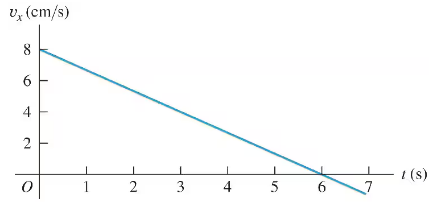
A cat walks in a straight line, which we shall call the -axis, with the positive direction to the right. As an observant physicist, you make measurements of this cat's motion and construct a graph of the feline's velocity as a function of time (Fig. E). Find the cat's velocity at s and at s.

Verified step by step guidance
Verified video answer for a similar problem:
Key Concepts
Velocity
Velocity-Time Graph
Linear Motion
A cat walks in a straight line, which we shall call the -axis, with the positive direction to the right. As an observant physicist, you make measurements of this cat's motion and construct a graph of the feline's velocity as a function of time (Fig. E). What distance does the cat move during the first s? From to s?
A car sits on an entrance ramp to a freeway, waiting for a break in the traffic. Then the driver accelerates with constant acceleration along the ramp and onto the freeway. The car starts from rest, moves in a straight line, and has a speed of m/s ( mi/h) when it reaches the end of the -m-long ramp. What is the acceleration of the car?
A cat walks in a straight line, which we shall call the -axis, with the positive direction to the right. As an observant physicist, you make measurements of this cat's motion and construct a graph of the feline's velocity as a function of time (Fig. E). What is the cat's acceleration at s? At s? At s?
A cat walks in a straight line, which we shall call the -axis, with the positive direction to the right. As an observant physicist, you make measurements of this cat's motion and construct a graph of the feline's velocity as a function of time (Fig. E). Assuming that the cat started at the origin, sketch clear graphs of the cat's acceleration and position as functions of time.
The human body can survive an acceleration trauma incident (sudden stop) if the magnitude of the acceleration is less than m/s2. If you are in an automobile accident with an initial speed of km/h ( mi/h) and are stopped by an airbag that inflates from the dashboard, over what distance must the airbag stop you for you to survive the crash?
