A car sits on an entrance ramp to a freeway, waiting for a break in the traffic. Then the driver accelerates with constant acceleration along the ramp and onto the freeway. The car starts from rest, moves in a straight line, and has a speed of m/s ( mi/h) when it reaches the end of the -m-long ramp. How much time does it take the car to travel the length of the ramp?
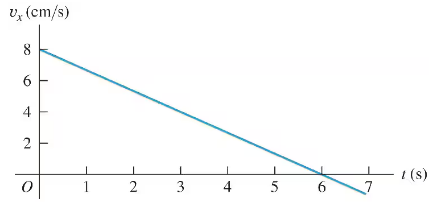
A cat walks in a straight line, which we shall call the -axis, with the positive direction to the right. As an observant physicist, you make measurements of this cat's motion and construct a graph of the feline's velocity as a function of time (Fig. E). What distance does the cat move during the first s? From to s?

Verified step by step guidance
Verified video answer for a similar problem:
Key Concepts
Velocity
Area under the Velocity-Time Graph
Linear Motion
If a flea can jump straight up to a height of m, what is its initial speed as it leaves the ground?
A cat walks in a straight line, which we shall call the -axis, with the positive direction to the right. As an observant physicist, you make measurements of this cat's motion and construct a graph of the feline's velocity as a function of time (Fig. E). What is the cat's acceleration at s? At s? At s?
A cat walks in a straight line, which we shall call the -axis, with the positive direction to the right. As an observant physicist, you make measurements of this cat's motion and construct a graph of the feline's velocity as a function of time (Fig. E). Find the cat's velocity at s and at s.
A small block has constant acceleration as it slides down a frictionless incline. The block is released from rest at the top of the incline, and its speed after it has traveled m to the bottom of the incline is m/s. What is the speed of the block when it is m from the top of the incline?
A cat walks in a straight line, which we shall call the -axis, with the positive direction to the right. As an observant physicist, you make measurements of this cat's motion and construct a graph of the feline's velocity as a function of time (Fig. E). Assuming that the cat started at the origin, sketch clear graphs of the cat's acceleration and position as functions of time.
