
Ch 36: Special Relativity
Knight Calc - Physics for Scientists and Engineers 5th Edition
Knight Calc5th EditionPhysics for Scientists and EngineersISBN: 9780137344796Not the one you use?Change textbook
Chapter 36, Problem 64b

Let's examine whether or not the law of conservation of momentum is true in all reference frames if we use the Newtonian definition of momentum: px = mux. Consider an object A of mass 3m at rest in reference frame S. Object A explodes into two pieces: object B, of mass m, that is shot to the left at a speed of c/2 and object C, of mass 2m, that, to conserve momentum, is shot to the right at a speed of c/4. Suppose this explosion is observed in reference frame S' that is moving to the right at half the speed of light. Use the Lorentz velocity transformation to find the velocities and the Newtonian momenta of B and C in S'.

Verified step by step guidance
1
Step 1: Understand the problem and identify the key concepts. The problem involves verifying the conservation of momentum in different reference frames using the Newtonian definition of momentum (p = mu). Additionally, the Lorentz velocity transformation is required to determine the velocities of objects B and C in the moving reference frame S'.
Step 2: Write down the Lorentz velocity transformation formula. The formula for transforming velocities between two reference frames is: \( u' = \frac{u - v}{1 - \frac{uv}{c^2}} \), where \( u \) is the velocity in the original frame (S), \( v \) is the relative velocity of the moving frame (S') with respect to S, and \( u' \) is the velocity in the moving frame (S').
Step 3: Apply the Lorentz velocity transformation to find the velocity of object B in S'. In reference frame S, object B moves to the left with a velocity of \( u_B = -\frac{c}{2} \). The relative velocity of S' with respect to S is \( v = \frac{c}{2} \). Substitute these values into the Lorentz velocity transformation formula to calculate \( u'_B \).
Step 4: Apply the Lorentz velocity transformation to find the velocity of object C in S'. In reference frame S, object C moves to the right with a velocity of \( u_C = \frac{c}{4} \). Again, use the relative velocity \( v = \frac{c}{2} \) and substitute these values into the Lorentz velocity transformation formula to calculate \( u'_C \).
Step 5: Calculate the Newtonian momenta of objects B and C in S'. Using the Newtonian definition of momentum \( p = mu \), calculate the momentum of object B as \( p'_B = m u'_B \) and the momentum of object C as \( p'_C = 2m u'_C \). Finally, check if the total momentum in S' (\( p'_B + p'_C \)) is equal to the total momentum in S (which is zero, since object A was initially at rest).

Verified video answer for a similar problem:

This video solution was recommended by our tutors as helpful for the problem above.
Was this helpful?

Key Concepts

Here are the essential concepts you must grasp in order to answer the question correctly.

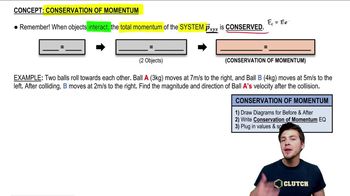
Conservation of Momentum

The law of conservation of momentum states that the total momentum of a closed system remains constant if no external forces act on it. In the context of collisions or explosions, this principle allows us to predict the velocities of objects after an event, provided we know their initial conditions. It is crucial for analyzing interactions in both classical and relativistic physics.
Recommended video:
Guided course
05:58
Conservation Of Momentum

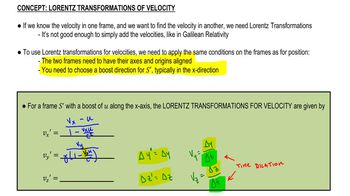
Lorentz Velocity Transformation

The Lorentz velocity transformation equations are used in special relativity to relate the velocities of objects as observed in different inertial reference frames. These transformations account for the effects of time dilation and length contraction at relativistic speeds, ensuring that the speed of light remains constant in all frames. Understanding these transformations is essential for analyzing scenarios involving high-speed motion.
Recommended video:
Guided course
13:39
Lorentz Transformations of Velocity

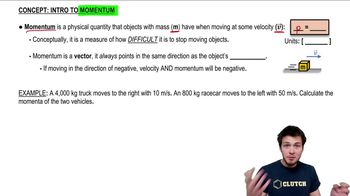
Newtonian Definition of Momentum

In classical mechanics, momentum is defined as the product of an object's mass and its velocity, expressed as p = mv. This definition is straightforward and applies well at low speeds, but it must be modified in relativistic contexts where velocities approach the speed of light. Recognizing the limitations of the Newtonian definition is important when applying it in scenarios involving relativistic effects.
Recommended video:
Guided course
05:17
Intro to Momentum
Related Practice
Textbook Question

A rocket is fired from the earth to the moon at a speed of 0.990c. Let two events be 'rocket leaves earth' and 'rocket hits moon.' In the earth's reference frame, calculate ∆x, ∆t, and the spacetime interval s for these events.

1
views
Textbook Question

The sun radiates energy at the rate 3.8 x 1026 W. The source of this energy is fusion, a nuclear reaction in which mass is transformed into energy. The mass of the sun is 2.0 x 1030 kg. Fusion takes place in the core of a star, where the temperature and pressure are highest. A star like the sun can sustain fusion until it has transformed about 0.10% of its total mass into energy, then fusion ceases and the star slowly dies. Estimate the sun's lifetime, giving your answer in billions of years.

1
views
Textbook Question

Derive a velocity transformation equation for uy and u'y. Assume that the reference frames are in the standard orientation with motion parallel to the x- and x'-axes.

1
views
Textbook Question

The sun radiates energy at the rate 3.8 x 1026 W. The source of this energy is fusion, a nuclear reaction in which mass is transformed into energy. The mass of the sun is 2.0 x 1030 kg. What percent is this of the sun's total mass?

2
views
Textbook Question

A rocket is fired from the earth to the moon at a speed of 0.990c. Let two events be 'rocket leaves earth' and 'rocket hits moon.' Repeat your calculations of part a if the rocket is replaced with a laser beam.

1
views
Textbook Question

At what speed, as a fraction of c, is the kinetic energy of a particle twice its Newtonian value?