
Ch 36: Special Relativity
Knight Calc - Physics for Scientists and Engineers 5th Edition
Knight Calc5th EditionPhysics for Scientists and EngineersISBN: 9780137344796Not the one you use?Change textbook
Chapter 36, Problem 63c

A rocket is fired from the earth to the moon at a speed of 0.990c. Let two events be 'rocket leaves earth' and 'rocket hits moon.' Repeat your calculations of part a if the rocket is replaced with a laser beam.

Verified step by step guidance
1
Step 1: Understand the problem. The rocket is traveling at a speed of 0.990c (where c is the speed of light) from Earth to the Moon. The two events are 'rocket leaves Earth' and 'rocket hits Moon.' The problem asks to repeat the calculations for a laser beam, which travels at the speed of light (c). This involves concepts of special relativity, particularly time dilation and simultaneity.
Step 2: Define the reference frames. There are two reference frames: the Earth-Moon frame (stationary relative to the rocket and laser beam) and the rocket/laser beam frame (moving relative to the Earth-Moon frame). For the laser beam, its speed is c, and it does not experience time dilation since it travels at the speed of light.
Step 3: Calculate the time taken for the rocket to travel from Earth to the Moon in the Earth-Moon frame. Use the formula for time: t=dv, where d is the distance between Earth and Moon, and v is the velocity of the rocket (0.990c). For the laser beam, its velocity is c, so the time taken in the Earth-Moon frame is t=dc.
Step 4: Consider the relativistic effects for the rocket. Time dilation occurs because the rocket is moving at a relativistic speed. The proper time experienced by the rocket is given by the formula: t'=t×1-v2c2. For the laser beam, no time dilation occurs because it travels at the speed of light.
Step 5: Compare the results. The rocket's travel time in the Earth-Moon frame is longer than the laser beam's travel time due to its slower speed. In the rocket's frame, the proper time is shorter due to time dilation. For the laser beam, the travel time in the Earth-Moon frame is simply dc, and no proper time is experienced by the beam itself.

Verified video answer for a similar problem:

This video solution was recommended by our tutors as helpful for the problem above.
Was this helpful?

Key Concepts

Here are the essential concepts you must grasp in order to answer the question correctly.

Relativity of Simultaneity

The relativity of simultaneity is a concept from Einstein's theory of relativity that states that two events that are simultaneous in one frame of reference may not be simultaneous in another. This is particularly important when considering high-speed travel, such as a rocket moving at a significant fraction of the speed of light (0.990c), as observers in different frames will perceive the timing of events differently.
Recommended video:
Guided course
04:27
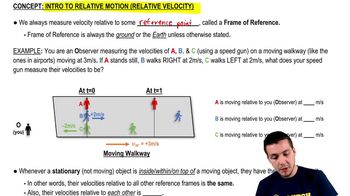
Intro to Relative Motion (Relative Velocity)

Time Dilation

Time dilation is a phenomenon predicted by the theory of relativity, where time passes at different rates for observers in different frames of reference, especially at high velocities. For an observer on Earth, the time taken for the rocket to travel to the moon will differ from the time experienced by the rocket itself, which will be less due to its high speed approaching the speed of light.
Recommended video:
Guided course
12:57
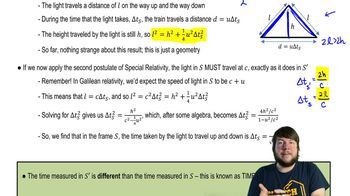
Time Dilation

Speed of Light as a Constant

The speed of light in a vacuum is a fundamental constant of nature, approximately 299,792 kilometers per second (or about 186,282 miles per second). According to relativity, no object with mass can reach or exceed this speed, and light itself serves as a universal speed limit. This concept is crucial when comparing the travel times of a rocket and a laser beam, as the latter travels at the speed of light, while the former does not.
Recommended video:
Guided course
08:59
Phase Constant of a Wave Function
Related Practice
Textbook Question

A rocket is fired from the earth to the moon at a speed of 0.990c. Let two events be 'rocket leaves earth' and 'rocket hits moon.' In the earth's reference frame, calculate ∆x, ∆t, and the spacetime interval s for these events.

1
views
Textbook Question

The half-life of a muon at rest is 1.5 μs. Muons that have been accelerated to a very high speed and are then held in a circular storage ring have a half-life of 7.5 μs. What is the total energy of a muon in the storage ring? The mass of a muon is 207 times the mass of an electron.

1
views
Textbook Question

Let's examine whether or not the law of conservation of momentum is true in all reference frames if we use the Newtonian definition of momentum: px = mux. Consider an object A of mass 3m at rest in reference frame S. Object A explodes into two pieces: object B, of mass m, that is shot to the left at a speed of c/2 and object C, of mass 2m, that, to conserve momentum, is shot to the right at a speed of c/4. Suppose this explosion is observed in reference frame S' that is moving to the right at half the speed of light. Use the Lorentz velocity transformation to find the velocities and the Newtonian momenta of B and C in S'.

1
views
Textbook Question

Derive a velocity transformation equation for uy and u'y. Assume that the reference frames are in the standard orientation with motion parallel to the x- and x'-axes.

1
views
Textbook Question

The sun radiates energy at the rate 3.8 x 1026 W. The source of this energy is fusion, a nuclear reaction in which mass is transformed into energy. The mass of the sun is 2.0 x 1030 kg. What percent is this of the sun's total mass?

2
views
Textbook Question

At what speed, as a fraction of c, is the kinetic energy of a particle twice its Newtonian value?