The half-life of a muon at rest is 1.5 μs. Muons that have been accelerated to a very high speed and are then held in a circular storage ring have a half-life of 7.5 μs. What is the total energy of a muon in the storage ring? The mass of a muon is 207 times the mass of an electron.
A rocket is fired from the earth to the moon at a speed of 0.990c. Let two events be 'rocket leaves earth' and 'rocket hits moon.' In the earth's reference frame, calculate ∆x, ∆t, and the spacetime interval s for these events.
Verified step by step guidance
Verified video answer for a similar problem:
Key Concepts
Relativity of Simultaneity
Spacetime Interval
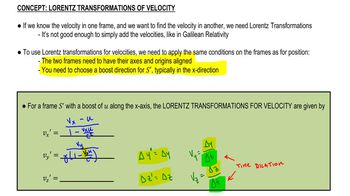
Lorentz Transformation
Let's examine whether or not the law of conservation of momentum is true in all reference frames if we use the Newtonian definition of momentum: px = mux. Consider an object A of mass 3m at rest in reference frame S. Object A explodes into two pieces: object B, of mass m, that is shot to the left at a speed of c/2 and object C, of mass 2m, that, to conserve momentum, is shot to the right at a speed of c/4. Suppose this explosion is observed in reference frame S' that is moving to the right at half the speed of light. Use the Lorentz velocity transformation to find the velocities and the Newtonian momenta of B and C in S'.

Derive a velocity transformation equation for uy and u'y. Assume that the reference frames are in the standard orientation with motion parallel to the x- and x'-axes.
Two rockets approach each other. Each is traveling at 0.75c in the earth's reference frame. What is the speed, as a fraction of c, of one rocket relative to the other?
A rocket is fired from the earth to the moon at a speed of 0.990c. Let two events be 'rocket leaves earth' and 'rocket hits moon.' Repeat your calculations of part a if the rocket is replaced with a laser beam.
At what speed, as a fraction of c, is the kinetic energy of a particle twice its Newtonian value?