
FIGURE CP35.50 shows a lens combination in which the lens separation is less than the focal length of the converging lens. The procedure for combination lenses is to let the image of the first lens be the object for the second lens, but in this case the image of the first lens—shown as a dot—is on the far side of the second lens. This is called a virtual object, a point that light rays are converging toward but never reach. The top half of Figure CP35.50 shows that the converging rays are refracted again by the diverging lens and come to a focus farther to the right. The procedure for combination lenses will continue to work if we use a negative object distance for a virtual object. Equation 35.1 defined the effective focal length feff of a lens combination, but we didn't discuss how it is used. Although an actual ray refracts twice, once at each lens, we can extend the output rays leftward to where they need to bend only once in a plane called the principal plane. The principal plane is similar to the lens plane of a single lens, where a single bend occurs, but the principal plane generally does not coincide with the physical lens; it's just a mathematical plane in space. The effective focal length is measured from the principal plane, so parallel input rays are focused at distance feff beyond the principal plane. Find the positions of the principal planes for lens separations of 5 cm and 10 cm. Give your answers as distances to the left of the diverging lens.

- Ch 01: Concepts of Motion35
- Ch 02: Kinematics in One Dimension75
- Ch 03: Vectors and Coordinate Systems58
- Ch 04: Kinematics in Two Dimensions60
- Ch 05: Force and Motion23
- Ch 06: Dynamics I: Motion Along a Line53
- Ch 07: Newton's Third Law27
- Ch 08: Dynamics II: Motion in a Plane52
- Ch 09: Work and Kinetic Energy56
- Ch 10: Interactions and Potential Energy50
- Ch 11: Impulse and Momentum56
- Ch 12: Rotation of a Rigid Body71
- Ch 13: Newton's Theory of Gravity52
- Ch 14: Fluids and Elasticity44
- Ch 15: Oscillations55
- Ch 16: Traveling Waves37
- Ch 17: Superposition39
- Ch 18: A Macroscopic Description of Matter53
- Ch 19: Work, Heat, and the First Law of Thermodynamics60
- Ch 20: The Micro/Macro Connection53
- Ch 21: Heat Engines and Refrigerators34
- Ch 22: Electric Charges and Forces40
- Ch 23: The Electric Field39
- Ch 24: Gauss' Law32
- Ch 25: The Electric Potential63
- Ch 26: Potential and Field57
- Ch 27: Current and Resistance42
- Ch 28: Fundamentals of Circuits39
- Ch 29: The Magnetic Field47
- Ch 30: Electromagnetic Induction60
- Ch 31: Electromagnetic Fields and Waves32
- Ch 32: AC Circuits63
- Ch 33: Wave Optics32
- Ch 34: Ray Optics57
- Ch 35: Optical Instruments30
- Ch 36: Special Relativity38
- Ch 37: The Foundations of Modern Physics25
- Ch 38: Quantization49
- Ch 39: Wave Functions and Uncertainty31
- Ch 40: One-Dimensional Quantum Mechanics35
- Ch 41: Atomic Physics18
- Ch 42: Nuclear Physics27
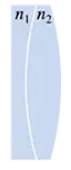
The lens shown in FIGURE CP35.49 is called an achromatic doublet, meaning that it has no chromatic aberration. The left side is flat, and all other surfaces have radii of curvature R. Because of dispersion, either lens alone would focus red rays and blue rays at different points. Define ∆n1 and ∆n2 as nblue - nred for the two lenses. What value of the ratio ∆n1 / ∆n2 makes fblue = fred for the two-lens system? That is, the two-lens system does not exhibit chromatic aberration.
 Verified step by step guidance
Verified video answer for a similar problem:
Key Concepts
Chromatic Aberration
 05:42
05:42
Refractive Index and Dispersion
 03:46
03:46Focal Length and Lens Combination
 05:38
05:38Alpha Centauri, the nearest star to our solar system, is 4.3 light years away. Assume that Alpha Centauri has a planet with an advanced civilization. Professor Dhg, at the planet’s Astronomical Institute, wants to build a telescope with which he can find out whether any planets are orbiting our sun. Building a telescope of the necessary size does not appear to be a major problem. What practical difficulties might prevent Professor Dhg’s experiment from succeeding?
A beam of white light enters a transparent material. Wavelengths for which the index of refraction is n are refracted at angle θ₂. Wavelengths for which the index of refraction is n + δn, where δn << n, are refracted at angle θ₂ + δθ. A beam of white light is incident on a piece of glass at 30°. Deep violet light is refracted 0.28° more than deep red light. The index of refraction for deep red light is known to be 1.552. What is the index of refraction for deep violet light?
The Hubble Space Telescope has a mirror diameter of 2.4 m. Suppose the telescope is used to photograph stars near the center of our galaxy, 30,000 light years away, using red light with a wavelength of 650 nm. For comparison, what is this distance as a multiple of the distance of Jupiter from the sun?