
Ch 35: Optical Instruments
Knight Calc - Physics for Scientists and Engineers 5th Edition
Knight Calc5th EditionPhysics for Scientists and EngineersISBN: 9780137344796Not the one you use?Change textbook
Chapter 35, Problem 50b

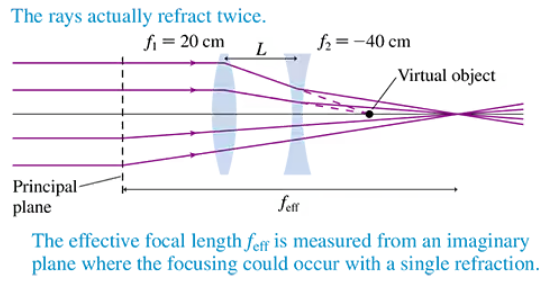
FIGURE CP35.50 shows a lens combination in which the lens separation is less than the focal length of the converging lens. The procedure for combination lenses is to let the image of the first lens be the object for the second lens, but in this case the image of the first lens—shown as a dot—is on the far side of the second lens. This is called a virtual object, a point that light rays are converging toward but never reach. The top half of Figure CP35.50 shows that the converging rays are refracted again by the diverging lens and come to a focus farther to the right. The procedure for combination lenses will continue to work if we use a negative object distance for a virtual object. Equation 35.1 defined the effective focal length feff of a lens combination, but we didn't discuss how it is used. Although an actual ray refracts twice, once at each lens, we can extend the output rays leftward to where they need to bend only once in a plane called the principal plane. The principal plane is similar to the lens plane of a single lens, where a single bend occurs, but the principal plane generally does not coincide with the physical lens; it's just a mathematical plane in space. The effective focal length is measured from the principal plane, so parallel input rays are focused at distance feff beyond the principal plane. Find the positions of the principal planes for lens separations of 5 cm and 10 cm. Give your answers as distances to the left of the diverging lens.

Verified step by step guidance
1
Step 1: Start by recalling the formula for the effective focal length of a lens combination: feff=(1/f1+1/f2d/(f1f2))⁻¹, where f1 and f2 are the focal lengths of the converging and diverging lenses, respectively, and d is the separation between the lenses.
Step 2: Use the effective focal length formula to calculate the effective focal length for each lens separation (5 cm and 10 cm). Substitute the given values for f1, f2, and d into the formula. Ensure that the focal length of the diverging lens is negative, as it is a diverging lens.
Step 3: Once the effective focal length is determined, recall that the principal plane is a mathematical plane where the lens combination behaves as if it were a single lens. The position of the principal plane can be found using the formula: x=(f1feff)/(f1f2), where x is the distance of the principal plane from the diverging lens.
Step 4: Substitute the values of f1, f2, and feff into the formula for x to calculate the position of the principal plane for each lens separation (5 cm and 10 cm).
Step 5: Interpret the results. The calculated values of x will give the positions of the principal planes relative to the diverging lens. Ensure that the distances are expressed as being to the left of the diverging lens, as specified in the problem.

Verified video answer for a similar problem:

This video solution was recommended by our tutors as helpful for the problem above.
Video duration:
14m
Was this helpful?

Key Concepts

Here are the essential concepts you must grasp in order to answer the question correctly.

Virtual Object

A virtual object is a point from which light rays appear to diverge but do not actually converge. In the context of lens systems, it occurs when the image formed by the first lens serves as the object for the second lens, even though it is located on the opposite side of the second lens. This concept is crucial for understanding how light behaves in complex lens arrangements, particularly when dealing with multiple lenses.
Recommended video:
Guided course
06:36
Charging Objects

Effective Focal Length

The effective focal length (fₑ) of a lens combination is a single value that describes the overall focusing power of multiple lenses working together. It is derived from the individual focal lengths and the distances between the lenses. This concept simplifies the analysis of lens systems by allowing us to treat them as a single lens with a specific focal length, making calculations of image formation more straightforward.
Recommended video:
Guided course
07:40
The Doppler Effect

Principal Plane

The principal plane is an imaginary plane in a lens system where the light rays can be considered to bend only once, similar to a single lens. It does not necessarily coincide with the physical location of the lenses and is used to simplify the analysis of ray paths. Understanding the principal plane is essential for determining the effective focal length and the behavior of light as it passes through multiple lenses.
Recommended video:
Guided course
06:59
Intro to Inclined Planes
Related Practice
Textbook Question

Alpha Centauri, the nearest star to our solar system, is 4.3 light years away. Assume that Alpha Centauri has a planet with an advanced civilization. Professor Dhg, at the planet’s Astronomical Institute, wants to build a telescope with which he can find out whether any planets are orbiting our sun. Building a telescope of the necessary size does not appear to be a major problem. What practical difficulties might prevent Professor Dhg’s experiment from succeeding?

1
views
Textbook Question

A beam of white light enters a transparent material. Wavelengths for which the index of refraction is n are refracted at angle θ₂. Wavelengths for which the index of refraction is n + δn, where δn << n, are refracted at angle θ₂ + δθ. A beam of white light is incident on a piece of glass at 30°. Deep violet light is refracted 0.28° more than deep red light. The index of refraction for deep red light is known to be 1.552. What is the index of refraction for deep violet light?

1
views
Textbook Question

The lens shown in FIGURE CP35.49 is called an achromatic doublet, meaning that it has no chromatic aberration. The left side is flat, and all other surfaces have radii of curvature R. Because of dispersion, either lens alone would focus red rays and blue rays at different points. Define ∆n1 and ∆n2 as nblue - nred for the two lenses. What value of the ratio ∆n1 / ∆n2 makes fblue = fred for the two-lens system? That is, the two-lens system does not exhibit chromatic aberration.

1
views