
Textbook Question
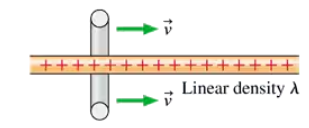
What is the force (magnitude and direction) on the proton in FIGURE P31.28? Give the direction as an angle cw or ccw from vertical.
1
views

 Verified step by step guidance
 06:28
06:28
 10:47
10:47 13:39
13:39What is the force (magnitude and direction) on the proton in FIGURE P31.28? Give the direction as an angle cw or ccw from vertical.
A proton is fired with a speed of 1.0×10⁶ m/s through the parallel-plate capacitor shown in FIGURE P31.29. The capacitor's electric field is E =(1.0×10⁵ V/m, down). How does an experimenter in the proton's frame explain that the proton experiences no force as the charged plates fly by?
A simple series circuit consists of a 150 Ω resistor, a 25 V battery, a switch, and a 2.5 pF parallel-plate capacitor (initially uncharged) with plates 5.0 mm apart. The switch is closed at t = 0 s. Find the electric flux and the displacement current at t = 0.50 ns.
A wire with conductivity σ carries current I. The current is increasing at the rate dI/dt. Evaluate the displacement current for a copper wire in which the current is increasing at 1.0×10⁶ A/s.
An electron travels with through a point in space where and . What is the force on the electron?
A 10 A current is charging a 1.0-cm-diameter parallel-plate capacitor. What is the magnetic field strength at a point 2.0 mm radially from the center of the capacitor?