
Ch 31: Electromagnetic Fields and Waves
Knight Calc - Physics for Scientists and Engineers 5th Edition
Knight Calc5th EditionPhysics for Scientists and EngineersISBN: 9780137344796Not the one you use?Change textbook
Chapter 31, Problem 28

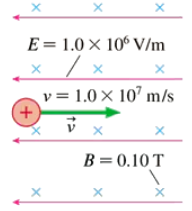
What is the force (magnitude and direction) on the proton in FIGURE P31.28? Give the direction as an angle cw or ccw from vertical.

Verified step by step guidance
1
Step 1: Identify the forces acting on the proton. The proton experiences two forces: the electric force due to the electric field \( E \) and the magnetic force due to the magnetic field \( B \). The electric force is given by \( F_E = qE \), and the magnetic force is given by \( F_B = qvB \sin \theta \), where \( \theta \) is the angle between the velocity \( \vec{v} \) and the magnetic field \( \vec{B} \).
Step 2: Calculate the electric force. The charge of the proton is \( q = 1.6 \times 10^{-19} \, \text{C} \), and the electric field \( E \) is \( 1.0 \times 10^6 \, \text{V/m} \). Use the formula \( F_E = qE \) to find the magnitude of the electric force.
Step 3: Calculate the magnetic force. The proton's velocity \( v \) is \( 1.0 \times 10^7 \, \text{m/s} \), the magnetic field \( B \) is \( 0.10 \, \text{T} \), and the angle \( \theta \) between \( \vec{v} \) and \( \vec{B} \) is \( 90^\circ \) (since \( \vec{v} \) is horizontal and \( \vec{B} \) is perpendicular to the plane). Use the formula \( F_B = qvB \sin \theta \) to find the magnitude of the magnetic force.
Step 4: Determine the net force. The electric force \( \vec{F_E} \) acts vertically upward, while the magnetic force \( \vec{F_B} \) acts horizontally to the left. Use vector addition to find the magnitude and direction of the net force. The magnitude is \( F_{\text{net}} = \sqrt{F_E^2 + F_B^2} \), and the direction is given by \( \tan \phi = \frac{F_B}{F_E} \), where \( \phi \) is the angle of the net force relative to the vertical.
Step 5: Express the direction of the net force. Convert the angle \( \phi \) into a clockwise (cw) or counterclockwise (ccw) direction from the vertical, depending on the orientation of the forces. The magnetic force is to the left, and the electric force is upward, so the net force will be at an angle \( \phi \) ccw from the vertical.

Verified video answer for a similar problem:

This video solution was recommended by our tutors as helpful for the problem above.
Was this helpful?

Key Concepts

Here are the essential concepts you must grasp in order to answer the question correctly.

Electric Field (E)

An electric field is a region around a charged particle where other charged particles experience a force. It is quantified in volts per meter (V/m) and indicates the direction a positive test charge would move. In this scenario, the electric field strength is given as 1.0 × 10^6 V/m, which influences the proton's motion.
Recommended video:
Guided course
03:16
Intro to Electric Fields

Magnetic Field (B)

A magnetic field is a vector field that exerts a force on moving charges and magnetic dipoles. It is measured in teslas (T) and can affect the trajectory of charged particles. In this case, the magnetic field strength is 0.10 T, which will interact with the proton's velocity to determine the net force acting on it.
Recommended video:
Guided course
05:30
Magnetic Fields and Magnetic Dipoles

Lorentz Force

The Lorentz force is the combined force exerted on a charged particle due to electric and magnetic fields. It is calculated using the formula F = q(E + v × B), where q is the charge, E is the electric field, v is the velocity, and B is the magnetic field. This force will dictate both the magnitude and direction of the force acting on the proton in the given scenario.
Recommended video:
Guided course
13:39
Lorentz Transformations of Velocity
Related Practice
Textbook Question

Unpolarized light with intensity 350 W/m2 passes first through a polarizing filter with its axis vertical, then through a second polarizing filter. It emerges from the second filter with intensity 131 W/m2. What is the angle from vertical of the axis of the second polarizing filter?

11
views
Textbook Question

In FIGURE P31.32, a circular loop of radius r travels with speed v along a charged wire having linear charge density λ. The wire is at rest in the laboratory frame, and it passes through the center of the loop. What electric and magnetic fields would an experimenter in the loop's frame calculate at distance r from the current of part c?

1
views
Textbook Question

FIGURE EX31.23 shows a horizontally polarized radio wave of frequency 1.0×10⁶ Hz traveling into the figure. The maximum electric field strength is 1000 V/m. What is the maximum magnetic field strength?

1
views
Textbook Question

A proton is fired with a speed of 1.0×10⁶ m/s through the parallel-plate capacitor shown in FIGURE P31.29. The capacitor's electric field is E =(1.0×10⁵ V/m, down). How does an experimenter in the proton's frame explain that the proton experiences no force as the charged plates fly by?

2
views
Textbook Question

An electron travels with v=(5.0×10⁶i^)m/s\(\vec{v}\) = (5.0 \(\times\) 10^6\,\(\hat{i}\))\,\(\text{m/s}\) through a point in space where E=(2.0×10⁵i^2.0×10⁵j^)V/m\(\vec{E}\) = (2.0 \(\times\) 10^5\,\(\hat{i}\) - 2.0 \(\times\) 10^5\,\(\hat{j}\))\,\(\text{V/m}\) and B=0.10k^T\(\vec{B}\) = -0.10\,\(\hat{k}\)\,\(\text{T}\). What is the force on the electron?

1
views
Textbook Question

A microwave beam with a wavelength of 1.5 cm has an intensity of 25 W/m2. What is the magnetic field amplitude?

1
views