
In FIGURE P31.32, a circular loop of radius r travels with speed v along a charged wire having linear charge density λ. The wire is at rest in the laboratory frame, and it passes through the center of the loop. What electric and magnetic fields would an experimenter in the loop's frame calculate at distance r from the current of part c?
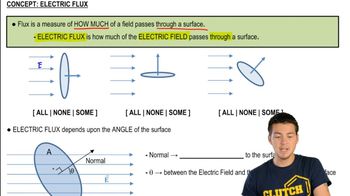
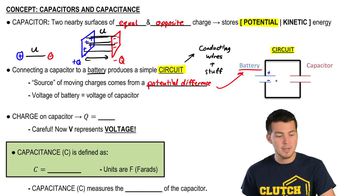
A simple series circuit consists of a 150 Ω resistor, a 25 V battery, a switch, and a 2.5 pF parallel-plate capacitor (initially uncharged) with plates 5.0 mm apart. The switch is closed at t = 0 s. Find the electric flux and the displacement current at t = 0.50 ns.
Verified step by step guidance
Verified video answer for a similar problem:
Key Concepts
Electric Flux
Displacement Current
Capacitance and Charging of Capacitors
A proton is fired with a speed of 1.0×10⁶ m/s through the parallel-plate capacitor shown in FIGURE P31.29. The capacitor's electric field is E =(1.0×10⁵ V/m, down). How does an experimenter in the proton's frame explain that the proton experiences no force as the charged plates fly by?
A wire with conductivity σ carries current I. The current is increasing at the rate dI/dt. Evaluate the displacement current for a copper wire in which the current is increasing at 1.0×10⁶ A/s.
An electron travels with through a point in space where and . What is the force on the electron?
A 10 A current is charging a 1.0-cm-diameter parallel-plate capacitor. What is the magnetic field strength at a point 2.0 mm radially from the center of the capacitor?
FIGURE P31.38 shows the electric field inside a cylinder of radius mm. The field strength is increasing with time as V/m, where t is in s. The electric field outside the cylinder is always zero, and the field inside the cylinder was zero for . Find an expression for the electric flux through the entire cylinder as a function of time.
