
Ch 30: Electromagnetic Induction
Knight Calc - Physics for Scientists and Engineers 5th Edition
Knight Calc5th EditionPhysics for Scientists and EngineersISBN: 9780137344796Not the one you use?Change textbook
Chapter 30, Problem 40

CALC A 10 cm×10 cm square loop of wire lies in the xy-plane. The magnetic field in this region of space is B=(0.30ti^+0.50t2k^) T\(\vec{B}\) = (0.30t\(\hat{i}\) + 0.50t^2\(\hat{k}\))\(\text{ T}\), where t is in s. What is the emf induced in the loop at (a) t = 0.5 s and (b) t = 1.0 s?

Verified step by step guidance
1
Understand the problem: The problem involves calculating the electromotive force (emf) induced in a square loop of wire due to a time-varying magnetic field. The emf is related to the rate of change of magnetic flux through the loop.
Write the formula for emf: The induced emf (ε) is given by Faraday's Law of Induction: ε = -dΦ/dt, where Φ is the magnetic flux through the loop. Magnetic flux is defined as Φ = ∫B⃗ ·dA⃗, where B⃗ is the magnetic field and dA⃗ is the area vector perpendicular to the loop.
Determine the magnetic flux: The loop lies in the xy-plane, so the area vector dA⃗ points in the z-direction (k̂). The magnetic field component contributing to the flux is the z-component, Bz = 0.50t². The area of the square loop is A = (0.10 m)² = 0.01 m². Thus, Φ = Bz × A = (0.50t²) × (0.01).
Differentiate the flux with respect to time: To find the emf, calculate dΦ/dt. Differentiate Φ = 0.50t² × 0.01 with respect to t. This gives dΦ/dt = d/dt [0.50 × 0.01 × t²] = 0.50 × 0.01 × 2t = 0.01t.
Substitute the given times: For part (a), substitute t = 0.5 s into the expression for dΦ/dt to find the emf. For part (b), substitute t = 1.0 s into the same expression. Remember to include the negative sign from Faraday's Law, so ε = -0.01t.

Verified video answer for a similar problem:

This video solution was recommended by our tutors as helpful for the problem above.
Was this helpful?

Key Concepts

Here are the essential concepts you must grasp in order to answer the question correctly.

Faraday's Law of Electromagnetic Induction

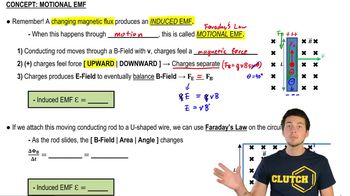
Faraday's Law states that a change in magnetic flux through a closed loop induces an electromotive force (emf) in the loop. The induced emf is proportional to the rate of change of magnetic flux, which can be calculated using the formula emf = -dΦ/dt, where Φ is the magnetic flux. This principle is fundamental in understanding how electric currents can be generated by changing magnetic fields.
Recommended video:
Guided course
09:26
Faraday's Law

Magnetic Flux

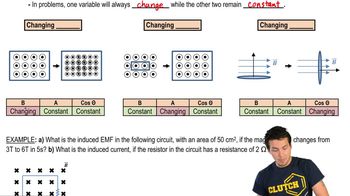
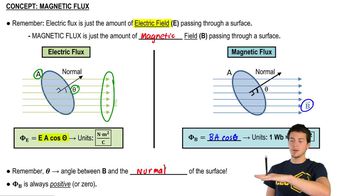
Magnetic flux (Φ) is a measure of the quantity of magnetism, taking into account the strength and the extent of a magnetic field. It is defined as the product of the magnetic field (B) and the area (A) through which the field lines pass, adjusted for the angle (θ) between the field lines and the normal to the surface: Φ = B·A·cos(θ). In this problem, the magnetic field varies with time, affecting the flux through the loop.
Recommended video:
Guided course
04:52
Magnetic Flux

Induced EMF Calculation

To calculate the induced emf in the loop at specific times, one must first determine the magnetic field at those times and then compute the magnetic flux through the loop. The emf can be found by differentiating the magnetic flux with respect to time. This involves substituting the values of the magnetic field into the flux equation and applying the appropriate time derivatives to find the induced emf at t = 0.5 s and t = 1.0 s.
Recommended video:
Related Practice
Textbook Question

A 2.0 cm×2.0 cm square loop of wire with resistance 0.010 Ω has one edge parallel to a long straight wire. The near edge of the loop is 1.0 cm from the wire. The current in the wire is increasing at the rate of 100 A/s. What is the current in the loop?

1
views
Textbook Question

At t = 0 s, the current in the circuit in FIGURE EX30.35 is I0. At what time in μs is the current (1/2)I0?

1
views
Textbook Question

CALC An 8.0 cm×8.0 cm square loop is halfway into a magnetic field perpendicular to the plane of the loop. The loop's mass is 10 g and its resistance is 0.010 Ω. A switch is closed at t = 0 s, causing the magnetic field to increase from 0 to 1.0 T in 0.010 s. Hint: What is the impulse on the loop? With what speed is the loop 'kicked' away from the magnetic field?

1
views
Textbook Question

FIGURE P30.47 shows a 1.0-cm-diameter loop with R = 0.50 Ω inside a 2.0-cm-diameter solenoid. The solenoid is 8.0 cm long, has 120 turns, and carries the current shown in the graph. A positive current is cw when seen from the left. Determine the current in the loop at t = 0.010 s.

2
views
Textbook Question

A 100-turn, 2.0-cm-diameter coil is at rest with its axis vertical. A uniform magnetic field 60° away from vertical increases from 0.50 T to 1.50 T in 0.60 s. What is the induced emf in the coil?

1
views
Textbook Question

The switch in FIGURE EX30.32 has been in position 1 for a long time. It is changed to position 2 at t = 0 s. What is the first time at which the current is maximum?

2
views