Ch 30: Electromagnetic Induction
Knight Calc - Physics for Scientists and Engineers 5th Edition
Knight Calc5th EditionPhysics for Scientists and EngineersISBN: 9780137344796Not the one you use?Change textbook
Chapter 30, Problem 35

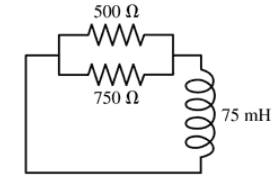
At t = 0 s, the current in the circuit in FIGURE EX30.35 is I0. At what time in μs is the current (1/2)I0?

Verified step by step guidance
1
Identify the type of circuit in the problem. Based on the context, this is likely an RL (resistor-inductor) circuit, where the current decays exponentially over time after the circuit is disconnected from a power source.
Write the equation for the current in an RL circuit as a function of time: I=I0e⁢−tτ, where I is the current at time t, I0 is the initial current, and τ is the time constant of the circuit.
Substitute the condition given in the problem: the current is 12I0 at some time t. This gives the equation: 12I0=I0e⁢−tτ.
Simplify the equation by dividing both sides by I0, resulting in: 12=e⁢−tτ. Take the natural logarithm of both sides to solve for t: tτ=ln(12).
Rearrange the equation to isolate t: t=τln(12). Substitute the value of the time constant τ (if provided in the problem or determined from the circuit parameters) to calculate the time t in microseconds.

Verified video answer for a similar problem:

This video solution was recommended by our tutors as helpful for the problem above.
Video duration:
4m
Was this helpful?

Key Concepts

Here are the essential concepts you must grasp in order to answer the question correctly.

Current in a Circuit

Current is the flow of electric charge in a circuit, measured in amperes (A). In this context, I₀ represents the initial current at time t=0 s. Understanding how current changes over time in response to circuit components, such as resistors and capacitors, is crucial for solving the problem.
Recommended video:
Guided course
03:45
Current in a Parallel RC AC Circuit

Exponential Decay

In circuits involving resistors and capacitors, the current often decreases exponentially over time due to the discharge of the capacitor. The mathematical representation of this decay can be expressed as I(t) = I₀ * e^(-t/τ), where τ is the time constant. Recognizing this behavior is essential for determining when the current reaches half of its initial value.
Recommended video:
Guided course
04:24
Amplitude Decay in an LRC Circuit

Time Constant (τ)

The time constant τ is a key parameter in RC circuits, defined as τ = R*C, where R is resistance and C is capacitance. It indicates the time it takes for the current to decrease to approximately 37% of its initial value. This concept helps in calculating the time required for the current to reach specific fractions of its initial value, such as 1/2 I₀.
Recommended video:
Guided course
08:59
Phase Constant of a Wave Function
Related Practice
Textbook Question

CALC A 10 cm×10 cm square loop of wire lies in the xy-plane. The magnetic field in this region of space is B=(0.30ti^+0.50t2k^) T\(\vec{B}\) = (0.30t\(\hat{i}\) + 0.50t^2\(\hat{k}\))\(\text{ T}\), where t is in s. What is the emf induced in the loop at (a) t = 0.5 s and (b) t = 1.0 s?

2
views

Textbook Question

CALC An 8.0 cm×8.0 cm square loop is halfway into a magnetic field perpendicular to the plane of the loop. The loop's mass is 10 g and its resistance is 0.010 Ω. A switch is closed at t = 0 s, causing the magnetic field to increase from 0 to 1.0 T in 0.010 s. Hint: What is the impulse on the loop? With what speed is the loop 'kicked' away from the magnetic field?

1
views
Textbook Question

A 2.0 mH inductor is connected in parallel with a variable capacitor. The capacitor can be varied from 100 pF to 200 pF. What is the range of oscillation frequencies for this circuit?

1
views
Textbook Question

BIO An MRI machine needs to detect signals that oscillate at very high frequencies. It does so with an LC circuit containing a 15 mH coil. To what value should the capacitance be set to detect a 450 MHz signal?

1
views
Textbook Question

A 100-turn, 2.0-cm-diameter coil is at rest with its axis vertical. A uniform magnetic field 60° away from vertical increases from 0.50 T to 1.50 T in 0.60 s. What is the induced emf in the coil?

1
views
Textbook Question

The switch in FIGURE EX30.32 has been in position 1 for a long time. It is changed to position 2 at t = 0 s. What is the first time at which the current is maximum?

2
views