Ch 28: Fundamentals of Circuits
Knight Calc - Physics for Scientists and Engineers 5th Edition
Knight Calc5th EditionPhysics for Scientists and EngineersISBN: 9780137344796Not the one you use?Change textbook
Chapter 28, Problem 14b

A typical American family uses 1000 kWh of electricity a month. On average, what is the resistance of a household?

Verified step by step guidance
1
Step 1: Begin by understanding the relationship between power, voltage, and resistance. The formula for electrical power is given by: P2 = VI, where P is power, V is voltage, and I is current.
Step 2: Convert the monthly energy usage into power. Since energy (E) is related to power (P) and time (t) by the formula Energy = Power Time .

Verified video answer for a similar problem:

This video solution was recommended by our tutors as helpful for the problem above.
Was this helpful?

Key Concepts

Here are the essential concepts you must grasp in order to answer the question correctly.

Ohm's Law

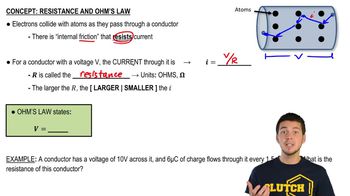
Ohm's Law states that the current (I) flowing through a conductor between two points is directly proportional to the voltage (V) across the two points and inversely proportional to the resistance (R). This relationship is expressed by the formula V = IR. Understanding this law is essential for calculating resistance when voltage and current are known.
Recommended video:
Guided course
03:07
Resistance and Ohm's Law

Power Consumption

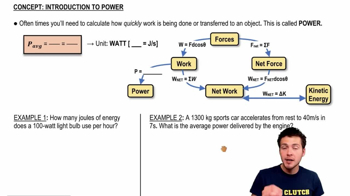
Power consumption in electrical systems is defined as the rate at which electrical energy is used, typically measured in watts (W). It can be calculated using the formula P = IV, where P is power, I is current, and V is voltage. In the context of household electricity usage, knowing the power consumption helps in determining the overall energy efficiency and resistance of household appliances.
Recommended video:

Energy and Time Relationship

The relationship between energy, power, and time is crucial for understanding electricity usage. Energy (in kilowatt-hours, kWh) is the product of power (in kilowatts) and time (in hours). For a household using 1000 kWh per month, this relationship allows us to derive average power consumption, which can then be used to find the average resistance of the household circuit when combined with voltage information.
Recommended video:
Guided course
03:43
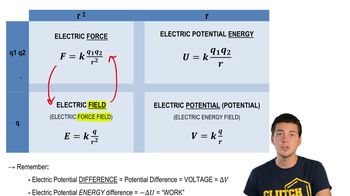
Relationships Between Force, Field, Energy, Potential