Ch 28: Fundamentals of Circuits
Knight Calc - Physics for Scientists and Engineers 5th Edition
Knight Calc5th EditionPhysics for Scientists and EngineersISBN: 9780137344796Not the one you use?Change textbook
Chapter 28, Problem 13

A 100 W (120 V) incandescent lightbulb contains a 7.0-cm-long tungsten filament. The high-temperature resistivity of tungsten is 9.0 x 10⁻⁷ Ωm. What is the diameter of the filament?

Verified step by step guidance
1
Step 1: Start by recalling the formula for electrical power: P = V2 / R, where P is power, V is voltage, and R is resistance. Rearrange this formula to solve for resistance: R = V2 / P.
Step 2: Substitute the given values for voltage (V = 120 V) and power (P = 100 W) into the formula to calculate the resistance of the filament: R = 1202 / 100.
Step 3: Use the formula for resistance in terms of resistivity: R = ρ L / A, where ρ is the resistivity, L is the length of the filament, and A is the cross-sectional area. Rearrange this formula to solve for the cross-sectional area: A = ρ L / R.
Step 4: Substitute the given values for resistivity (ρ = 9.0 × 10⁻⁷ Ωm), length (L = 0.07 m), and the resistance calculated in Step 2 into the formula for A to find the cross-sectional area.
Step 5: Recall that the cross-sectional area of a cylindrical filament is given by A = π (d / 2)2, where d is the diameter. Rearrange this formula to solve for the diameter: d = 2 √(A / π). Substitute the value of A from Step 4 to calculate the diameter of the filament.

Verified video answer for a similar problem:

This video solution was recommended by our tutors as helpful for the problem above.
Was this helpful?

Key Concepts

Here are the essential concepts you must grasp in order to answer the question correctly.

Resistivity

Resistivity is a material property that quantifies how strongly a given material opposes the flow of electric current. It is denoted by the symbol 'ρ' and is measured in ohm-meters (Ωm). For tungsten, the high-temperature resistivity is given as 9.0 x 10⁻⁷ Ωm, which is crucial for calculating the filament's resistance and, subsequently, its diameter.
Recommended video:
Guided course
05:25
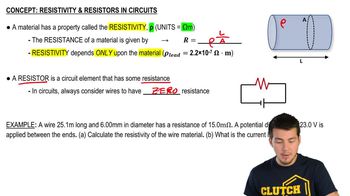
Resistivity & Resistors in Circuits

Resistance

Resistance is the opposition to the flow of electric current in a conductor, measured in ohms (Ω). It can be calculated using the formula R = ρ(L/A), where R is resistance, ρ is resistivity, L is the length of the conductor, and A is the cross-sectional area. Understanding resistance is essential for determining the filament's diameter based on its length and resistivity.
Recommended video:
Guided course
05:25
Resistivity & Resistors in Circuits

Cross-sectional Area

The cross-sectional area (A) of a cylindrical object, like a filament, is the area of a slice taken perpendicular to its length. For a circular filament, A can be calculated using the formula A = π(d/2)², where d is the diameter. This area is vital for relating the filament's resistance to its physical dimensions, allowing us to find the diameter from the known resistance and length.
Recommended video:
Guided course
08:10
Calculating the Vector (Cross) Product Using Components