Ch 28: Fundamentals of Circuits
Knight Calc - Physics for Scientists and Engineers 5th Edition
Knight Calc5th EditionPhysics for Scientists and EngineersISBN: 9780137344796Not the one you use?Change textbook
Chapter 28, Problem 14a

A typical American family uses 1000 kWh of electricity a month. What is the average current in the 120 V power line to the house?

Verified step by step guidance
1
Step 1: Begin by recalling the formula for electrical power, which is \( P = IV \), where \( P \) is power in watts, \( I \) is current in amperes, and \( V \) is voltage in volts.
Step 2: Convert the monthly energy usage from kilowatt-hours (kWh) to watts. Since 1 kWh = 1000 watt-hours, multiply the given energy usage (1000 kWh) by 1000 to get the energy in watt-hours.
Step 3: Divide the total energy in watt-hours by the number of hours in a month to find the average power. Assume a month has approximately 30 days, so there are \( 30 \times 24 = 720 \) hours in a month.
Step 4: Rearrange the power formula \( P = IV \) to solve for current \( I \). This gives \( I = \frac{P}{V} \). Substitute the average power calculated in Step 3 and the given voltage (120 V) into this formula.
Step 5: Perform the division to find the average current \( I \). The result will be in amperes (A), which represents the average current flowing through the power line to the house.

Verified video answer for a similar problem:

This video solution was recommended by our tutors as helpful for the problem above.
Was this helpful?

Key Concepts

Here are the essential concepts you must grasp in order to answer the question correctly.

Electric Power

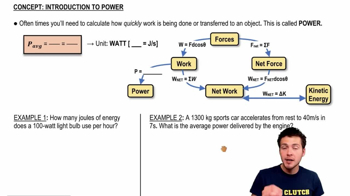
Electric power is the rate at which electrical energy is transferred by an electric circuit. It is measured in watts (W), where 1 watt equals 1 joule per second. The power consumed by a device can be calculated using the formula P = VI, where P is power, V is voltage, and I is current. Understanding this relationship is crucial for solving problems related to electricity consumption.
Recommended video:

Current

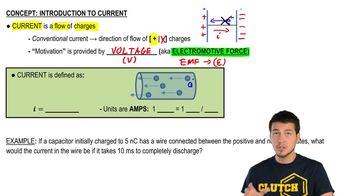
Current is the flow of electric charge in a circuit, measured in amperes (A). It represents the amount of charge passing through a point in the circuit per unit time. The average current can be calculated by rearranging the power formula to I = P/V, where I is current, P is power, and V is voltage. This concept is essential for determining how much current flows in a circuit based on power usage and voltage.
Recommended video:
Guided course
05:38
Intro to Current

Voltage

Voltage, or electric potential difference, is the measure of electric potential energy per unit charge between two points in a circuit. It is measured in volts (V) and indicates how much energy is available to move charges through a circuit. In this context, the standard voltage of 120 V is used to calculate the current based on the total power consumption of the household.
Recommended video:
Guided course
07:14
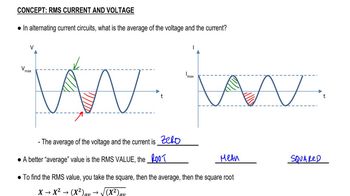
RMS Current and Voltage