Ch 26: Potential and Field
Knight Calc - Physics for Scientists and Engineers 5th Edition
Knight Calc5th EditionPhysics for Scientists and EngineersISBN: 9780137344796Not the one you use?Change textbook
Chapter 26, Problem 51

Metal sphere 1 has a positive charge of 6.0 nC. Metal sphere 2, which is twice the diameter of sphere 1, is initially uncharged. The spheres are then connected together by a long, thin metal wire. What are the final charges on each sphere?

Verified step by step guidance
1
Understand the concept: When two conductive spheres are connected by a wire, charge redistributes between them until they reach the same electric potential. The electric potential on a sphere is given by \( V = \frac{Q}{4 \pi \epsilon_0 R} \), where \( Q \) is the charge, \( R \) is the radius, and \( \epsilon_0 \) is the permittivity of free space.
Relate the radii of the spheres: Since sphere 2 has twice the diameter of sphere 1, its radius \( R_2 \) is twice that of sphere 1, i.e., \( R_2 = 2R_1 \).
Set up the condition for equilibrium: At equilibrium, the electric potentials of the two spheres are equal. Using \( V_1 = V_2 \), substitute the formula for potential: \( \frac{Q_1}{4 \pi \epsilon_0 R_1} = \frac{Q_2}{4 \pi \epsilon_0 R_2} \). Simplify to find \( \frac{Q_1}{R_1} = \frac{Q_2}{R_2} \).
Express the relationship between charges: Using \( R_2 = 2R_1 \), substitute into \( \frac{Q_1}{R_1} = \frac{Q_2}{R_2} \) to get \( Q_2 = 2Q_1 \). This means the charge on sphere 2 is twice that on sphere 1 after redistribution.
Conserve total charge: The total charge before and after redistribution must be the same. Initially, the total charge is \( Q_{total} = 6.0 \text{ nC} \). After redistribution, \( Q_1 + Q_2 = Q_{total} \). Substitute \( Q_2 = 2Q_1 \) into this equation to solve for \( Q_1 \) and \( Q_2 \).

Verified video answer for a similar problem:

This video solution was recommended by our tutors as helpful for the problem above.
Was this helpful?

Key Concepts

Here are the essential concepts you must grasp in order to answer the question correctly.

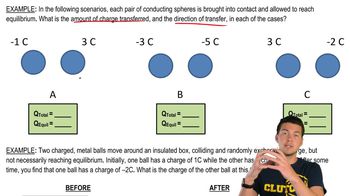
Charge Conservation

Charge conservation is a fundamental principle in physics stating that the total electric charge in an isolated system remains constant over time. When two conductive objects are connected, the total charge is redistributed between them, but the sum of their charges before and after the connection remains the same.
Recommended video:
Guided course
05:43
Conservation of Charge

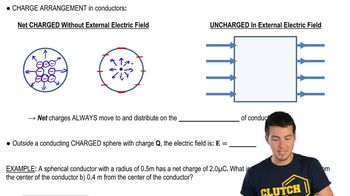
Conductors and Charge Distribution

Conductors allow electric charges to move freely. When two conductors are connected, charges will redistribute until they reach the same electric potential. The larger conductor (sphere 2) will hold more charge due to its greater surface area, leading to an unequal distribution of charge based on their sizes.
Recommended video:
Guided course
07:43
Electric Fields in Conductors

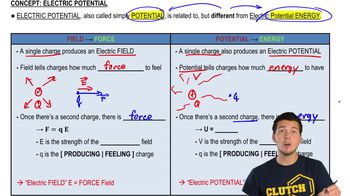
Electric Potential

Electric potential is the amount of electric potential energy per unit charge at a point in an electric field. When two spheres are connected, they will equalize their electric potentials. The final charge on each sphere can be determined by ensuring that the potential is the same across both spheres, taking into account their sizes and initial charges.
Recommended video:
Guided course
07:33
Electric Potential