Ch 26: Potential and Field
Knight Calc - Physics for Scientists and Engineers 5th Edition
Knight Calc5th EditionPhysics for Scientists and EngineersISBN: 9780137344796Not the one you use?Change textbook
Chapter 26, Problem 53

The electric potential is 40 V at point A near a uniformly charged sphere. At point B, 2.0 μm farther away from the sphere, the potential has decreased by 0.16 mV. How far is point A from the center of the sphere?

Verified step by step guidance
1
Understand that the electric potential (V) around a uniformly charged sphere is given by the formula: V=kqr, where k is Coulomb's constant, q is the charge of the sphere, and r is the distance from the center of the sphere.
Recognize that the change in potential between two points A and B is given by: ΔV=VA-VB. Substituting the formula for potential, this becomes: ΔV=kqrA-kqrB.
Since the problem states that the potential decreases by 0.16 mV when moving 2.0 μm farther from the sphere, express this as: ΔV=-0.16mV and rB=rA+2.0μm.
Substitute ΔV, rB, and the known values into the equation: -0.16mV=kqrA-kq(rA+2.0μm).
Simplify the equation to isolate rA. Cancel out k and q (since they are constants), and solve for rA using algebraic manipulation.

Verified video answer for a similar problem:

This video solution was recommended by our tutors as helpful for the problem above.
Video duration:
8m
Was this helpful?

Key Concepts

Here are the essential concepts you must grasp in order to answer the question correctly.

Electric Potential

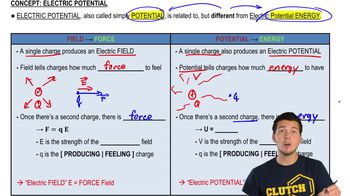
Electric potential, measured in volts (V), represents the potential energy per unit charge at a point in an electric field. It indicates how much work is needed to move a charge from a reference point to a specific point in the field. In this scenario, the potential at point A is given as 40 V, which is crucial for understanding the energy landscape around the charged sphere.
Recommended video:
Guided course
07:33
Electric Potential

Uniformly Charged Sphere

A uniformly charged sphere is an idealized model where charge is distributed evenly over the surface or throughout the volume of the sphere. The electric field outside such a sphere behaves as if all the charge were concentrated at its center, allowing for simplified calculations of electric potential and field strength. This concept is essential for determining how the potential changes with distance from the sphere.
Recommended video:
Guided course
05:43
Conservation of Charge

Potential Difference and Distance

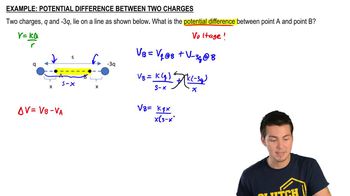
The potential difference between two points in an electric field is related to the work done in moving a charge between those points. In this case, the potential at point B is 0.16 mV lower than at point A, and the distance between them is 2.0 μm. Understanding how potential changes with distance helps in calculating the distance from point A to the center of the sphere using the relationship between potential difference and radial distance in the electric field of a charged sphere.
Recommended video:
Guided course
07:04
Potential Difference Between Two Charges