
Ch 26: Potential and Field
Knight Calc - Physics for Scientists and Engineers 5th Edition
Knight Calc5th EditionPhysics for Scientists and EngineersISBN: 9780137344796Not the one you use?Change textbook
Chapter 26, Problem 49c

Two positive point charges q are located on the y-axis at y = ±a. Symmetry dictates that the electric field along the x-axis has only an x-component: Ey=Ez=0. Find an expression for Ex if x≪a.

Verified step by step guidance
1
Step 1: Begin by recalling Coulomb's law, which states that the electric field due to a point charge is given by \( E = \frac{kq}{r^2} \), where \( k \) is Coulomb's constant, \( q \) is the charge, and \( r \) is the distance from the charge to the point of interest.
Step 2: Identify the geometry of the problem. The two charges \( q \) are located at \( y = +a \) and \( y = -a \), and the point of interest is along the x-axis at a distance \( x \) from the origin. The distance \( r \) from each charge to the point on the x-axis can be expressed as \( r = \sqrt{x^2 + a^2} \).
Step 3: Decompose the electric field contributions from each charge into components. The electric field due to each charge has both an x-component and a y-component. By symmetry, the y-components cancel out, leaving only the x-components. The x-component of the electric field from each charge is \( E_x = E \cdot \frac{x}{r} \), where \( E \) is the magnitude of the electric field.
Step 4: Sum the x-components of the electric field from both charges. Since the charges are identical and symmetrically placed, the total x-component of the electric field is \( E_x = 2 \cdot \frac{kq}{r^2} \cdot \frac{x}{r} \). Substitute \( r = \sqrt{x^2 + a^2} \) into the expression.
Step 5: Simplify the expression for \( E_x \) under the condition \( x \ll a \). When \( x \ll a \), \( \sqrt{x^2 + a^2} \approx a \), and \( r^2 \approx a^2 \). Using this approximation, the expression for \( E_x \) simplifies to \( E_x \approx \frac{2kxq}{a^3} \).

Verified video answer for a similar problem:

This video solution was recommended by our tutors as helpful for the problem above.
Was this helpful?

Key Concepts

Here are the essential concepts you must grasp in order to answer the question correctly.

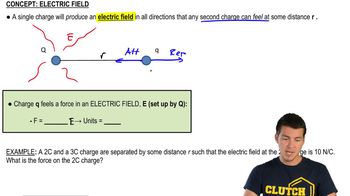
Electric Field

The electric field is a vector field that represents the force exerted by electric charges on other charges in space. It is defined as the force per unit charge and is directed away from positive charges and towards negative charges. The strength and direction of the electric field depend on the magnitude and position of the source charges.
Recommended video:
Guided course
03:16
Intro to Electric Fields

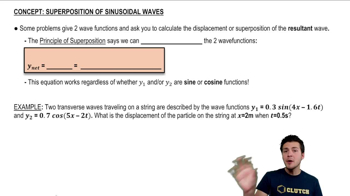
Superposition Principle

The superposition principle states that the total electric field created by multiple point charges is the vector sum of the electric fields produced by each charge individually. This principle allows us to analyze complex charge configurations by considering the contributions from each charge separately and then combining them to find the resultant field.
Recommended video:
Guided course
03:32
Superposition of Sinusoidal Wave Functions

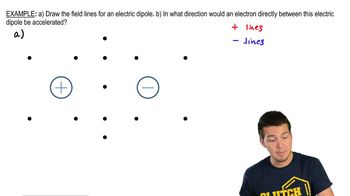
Symmetry in Electric Fields

Symmetry in electric fields refers to the predictable patterns that arise from the arrangement of charges. In this case, the two positive charges are symmetrically placed along the y-axis, leading to the conclusion that the electric field along the x-axis will have no y or z components (Ey = Ez = 0). This simplifies the analysis, allowing us to focus solely on the x-component of the electric field.
Recommended video:
Guided course
08:20
Electric Field Lines
Related Practice
Textbook Question

The electric field in a region of space is E=(800xı^600yȷ^)\(\overrightarrow{E}\)=(800xî-600yĵ) V/m , where x and y are in m. The zero of electric potential is at the origin. What are (a) the electric field and (b) the electric potential at the point (x,y)=(2.0 m, 1.0 m)? Hint: The potential difference is the same along any path connecting two points.

Textbook Question

Two positive point charges q are located on the y-axis at y = ±a. Your answer to part d shows that an electron experiences a linear restoring force, so it will undergo simple harmonic motion. What is the oscillation frequency in GHz for an electron moving between two 1.0 nC charges separated by 2.0 mm?

1
views
Textbook Question

The electric potential in a region of space is V=(150x2 − 200y2)V, where x and y are in meters. What are the strength and direction of the electric field at (x, y)=(2.0 m, 2.0 m)? Give the direction as an angle cw or ccw (specify which) from the positive x-axis.

2
views
Textbook Question

Metal sphere 1 has a positive charge of 6.0 nC. Metal sphere 2, which is twice the diameter of sphere 1, is initially uncharged. The spheres are then connected together by a long, thin metal wire. What are the final charges on each sphere?

1
views
Textbook Question

Two 2.0 cm×2.0 cm metal electrodes are spaced 1.0 mm apart and connected by wires to the terminals of a 9.0 V battery. The wires are disconnected, and insulated handles are used to pull the plates apart to a new spacing of 2.0 mm. What are the charge on each electrode and the potential difference between them?

2
views
Textbook Question

Two positive point charges q are located on the y-axis at y = ±a. Write an expression for the electric potential at position x on the x-axis.

2
views