Ch 26: Potential and Field
Knight Calc - Physics for Scientists and Engineers 5th Edition
Knight Calc5th EditionPhysics for Scientists and EngineersISBN: 9780137344796Not the one you use?Change textbook
Chapter 26, Problem 40

An infinitely long cylinder of radius R has linear charge density λ. The potential on the surface of the cylinder is V0, and the electric field outside the cylinder is Er = λ/2πϵ0r . Find the potential relative to the surface at a point that is distance r from the axis, assuming r>R.

Verified step by step guidance
1
Start by recalling the relationship between the electric field and the potential in electrostatics. The electric field is the negative gradient of the potential: \( E_r = -\frac{dV}{dr} \). Rearrange this to express the potential difference: \( dV = -E_r \, dr \).
Substitute the given expression for the electric field outside the cylinder, \( E_r = \frac{\lambda}{2\pi\epsilon_0 r} \), into the equation for \( dV \): \( dV = -\frac{\lambda}{2\pi\epsilon_0 r} \, dr \).
Integrate both sides to find the potential \( V(r) \) at a distance \( r \) from the axis. The integral becomes \( V(r) - V_0 = -\int_R^r \frac{\lambda}{2\pi\epsilon_0 r} \, dr \), where the limits of integration are from \( R \) (the surface of the cylinder) to \( r \) (the point of interest).
Evaluate the integral \( \int \frac{1}{r} \, dr \), which is \( \ln(r) \). Substituting this result, the equation becomes \( V(r) - V_0 = -\frac{\lambda}{2\pi\epsilon_0} [\ln(r) - \ln(R)] \).
Simplify the expression using the logarithmic property \( \ln(a) - \ln(b) = \ln(\frac{a}{b}) \). The final expression for the potential relative to the surface is \( V(r) = V_0 - \frac{\lambda}{2\pi\epsilon_0} \ln\left(\frac{r}{R}\right) \).

Verified video answer for a similar problem:

This video solution was recommended by our tutors as helpful for the problem above.
Was this helpful?

Key Concepts

Here are the essential concepts you must grasp in order to answer the question correctly.

Electric Potential

Electric potential is the amount of electric potential energy per unit charge at a point in an electric field. It is a scalar quantity that indicates the work done to move a unit positive charge from a reference point to a specific point in the field. In this context, the potential on the surface of the cylinder is given as V0, which serves as a reference for calculating the potential at a distance r from the axis.
Recommended video:
Guided course
07:33
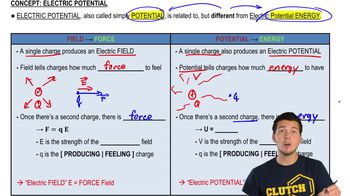
Electric Potential

Electric Field of a Charged Cylinder

The electric field outside an infinitely long charged cylinder is determined by its linear charge density (λ) and is given by the formula Er = λ/(2πϵ0 r). This field decreases with distance from the cylinder and is directed radially outward. Understanding this relationship is crucial for calculating the potential at a distance r from the cylinder's axis.
Recommended video:
Guided course
06:28
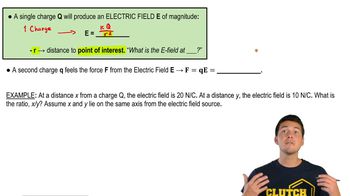
Electric Field due to a Point Charge

Integration in Electrostatics

In electrostatics, the potential difference between two points can be found by integrating the electric field along a path between those points. For a charged cylinder, this involves integrating the electric field from the surface (r = R) to the point at distance r. This process allows us to determine how the potential changes with distance in the presence of an electric field.
Recommended video:
Guided course
11:43
Finding Moment Of Inertia By Integrating