Ch 26: Potential and Field
Knight Calc - Physics for Scientists and Engineers 5th Edition
Knight Calc5th EditionPhysics for Scientists and EngineersISBN: 9780137344796Not the one you use?Change textbook
Chapter 26, Problem 43

Use the on-axis potential of a charged disk from Chapter 25 to find the on-axis electric field of a charged disk.

Verified step by step guidance
1
Start by recalling the formula for the on-axis electric potential of a uniformly charged disk. The potential at a point along the axis of the disk is given by: V(z) = σzε00R r(z2 + r2)1/2 dr, where σ is the surface charge density, ε0 is the permittivity of free space, z is the distance from the disk along the axis, and R is the radius of the disk.
To find the electric field, use the relationship between the electric field and the potential: E(z) = -dV(z)dz. This means you need to take the derivative of the potential with respect to z.
Differentiate the integral expression for V(z) with respect to z. Note that z appears both in the numerator and inside the square root in the denominator. Apply the chain rule carefully during differentiation.
Simplify the resulting expression for E(z). The electric field will involve an integral similar to the one in the potential formula, but with additional terms arising from the derivative.
Express the final formula for the on-axis electric field of the charged disk. The result should be in terms of σ, ε0, z, and R, and may still involve an integral that depends on r.

Verified video answer for a similar problem:

This video solution was recommended by our tutors as helpful for the problem above.
Video duration:
9m
Was this helpful?

Key Concepts

Here are the essential concepts you must grasp in order to answer the question correctly.

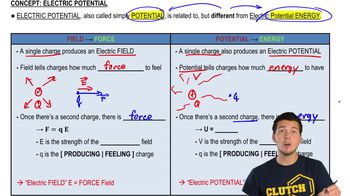
Electric Potential

Electric potential is the amount of electric potential energy per unit charge at a point in an electric field. For a charged disk, the potential at a point along its axis can be derived from the contributions of all infinitesimal charge elements on the disk. Understanding this concept is crucial for calculating the electric field, as the electric field is related to the gradient of the electric potential.
Recommended video:
Guided course
07:33
Electric Potential

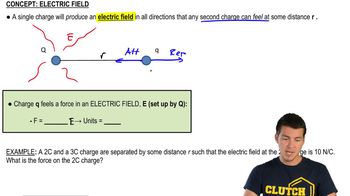
Electric Field

The electric field is a vector field that represents the force exerted by an electric charge on other charges in its vicinity. It is defined as the force per unit charge and can be calculated as the negative gradient of the electric potential. For a charged disk, the electric field on its axis can be derived from the potential by taking the derivative with respect to the distance from the disk.
Recommended video:
Guided course
03:16
Intro to Electric Fields

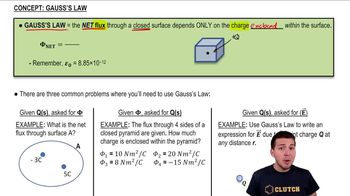
Gauss's Law

Gauss's Law relates the electric flux through a closed surface to the charge enclosed by that surface. It is a powerful tool for calculating electric fields in symmetric charge distributions. While the question focuses on the potential and field of a charged disk, Gauss's Law provides foundational insights into how electric fields behave around charged objects, which can aid in understanding the derivation of the electric field from the potential.
Recommended video:
Related Practice
Textbook Question

The electric field in a region of space is Ex = −1000x2 V/m, where x is in meters. What is the potential difference between xi = −20 cm and xf = 30 cm?

Textbook Question

Engineers discover that the electric potential between two electrodes can be modeled as V(x)=V0ln(1+x/d) , where V0 is a constant, x is the distance from the first electrode in the direction of the second, and d is the distance between the electrodes. What is the electric field strength midway between the electrodes?

3
views
Textbook Question

The electric field in a region of space is E=(800xı^600yȷ^)\(\overrightarrow{E}\)=(800xî-600yĵ) V/m , where x and y are in m. The zero of electric potential is at the origin. What are (a) the electric field and (b) the electric potential at the point (x,y)=(2.0 m, 1.0 m)? Hint: The potential difference is the same along any path connecting two points.

Textbook Question

An infinitely long cylinder of radius R has linear charge density λ. The potential on the surface of the cylinder is V0, and the electric field outside the cylinder is Er = λ/2πϵ0r . Find the potential relative to the surface at a point that is distance r from the axis, assuming r>R.

Textbook Question

The electric potential in a region of space is V=(150x2 − 200y2)V, where x and y are in meters. What are the strength and direction of the electric field at (x, y)=(2.0 m, 2.0 m)? Give the direction as an angle cw or ccw (specify which) from the positive x-axis.

2
views
Textbook Question

The electric field in a region of space is Ex = −1000x^2 V/m, where x is in meters. Graph Ex versus x over the region −1 m ≤ x ≤1 m.