Ch 26: Potential and Field
Knight Calc - Physics for Scientists and Engineers 5th Edition
Knight Calc5th EditionPhysics for Scientists and EngineersISBN: 9780137344796Not the one you use?Change textbook
Chapter 26, Problem 39b

The electric field in a region of space is Ex = −1000x2 V/m, where x is in meters. What is the potential difference between xi = −20 cm and xf = 30 cm?

Verified step by step guidance
1
Step 1: Recall the relationship between electric field and potential difference. The electric field is the negative gradient of the electric potential, expressed as \( E_x = -\frac{dV}{dx} \). To find the potential difference, integrate the electric field over the given range of \( x \).
Step 2: Write the expression for the electric field given in the problem: \( E_x = -1000x^2 \) V/m. The negative sign indicates the direction of the field.
Step 3: Set up the integral for the potential difference \( \Delta V \) between \( x_i \) and \( x_f \): \( \Delta V = -\int_{x_i}^{x_f} E_x \, dx \). Substitute \( E_x = -1000x^2 \) into the integral: \( \Delta V = -\int_{x_i}^{x_f} (-1000x^2) \, dx \).
Step 4: Simplify the integral: \( \Delta V = \int_{x_i}^{x_f} 1000x^2 \, dx \). Perform the integration: \( \Delta V = 1000 \int_{x_i}^{x_f} x^2 \, dx = 1000 \left[ \frac{x^3}{3} \right]_{x_i}^{x_f} \).
Step 5: Substitute the limits of integration \( x_i = -0.20 \) m and \( x_f = 0.30 \) m into the result: \( \Delta V = 1000 \left[ \frac{(0.30)^3}{3} - \frac{(-0.20)^3}{3} \right] \). Simplify the expression to find the potential difference.

Verified video answer for a similar problem:

This video solution was recommended by our tutors as helpful for the problem above.
Was this helpful?

Key Concepts

Here are the essential concepts you must grasp in order to answer the question correctly.

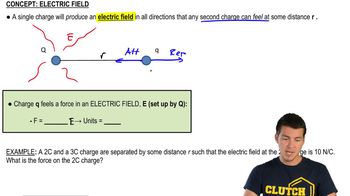
Electric Field

The electric field (E) is a vector field that represents the force per unit charge experienced by a positive test charge placed in the field. It is defined mathematically as the negative gradient of the electric potential (V), indicating how the potential changes with position. In this case, the electric field is given as Ex = -1000x^2 V/m, which shows how the field strength varies with the position along the x-axis.
Recommended video:
Guided course
03:16
Intro to Electric Fields

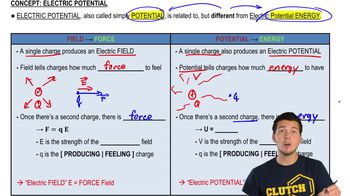
Electric Potential Difference

The electric potential difference (ΔV) between two points in an electric field is the work done per unit charge in moving a charge from one point to another. It can be calculated by integrating the electric field over the distance between the two points. In this problem, we need to find the potential difference between xi = -20 cm and xf = 30 cm, which involves evaluating the integral of the electric field expression over the specified limits.
Recommended video:
Guided course
07:33
Electric Potential

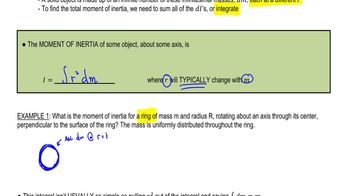
Integration in Physics

Integration is a fundamental mathematical tool used in physics to calculate quantities that accumulate over a continuous range. In the context of electric fields and potential differences, integration allows us to find the total work done by the electric field when moving a charge between two points. For the given electric field, we will integrate Ex with respect to x from the initial position to the final position to determine the potential difference.
Recommended video:
Guided course
11:43
Finding Moment Of Inertia By Integrating