Ch 26: Potential and Field
Knight Calc - Physics for Scientists and Engineers 5th Edition
Knight Calc5th EditionPhysics for Scientists and EngineersISBN: 9780137344796Not the one you use?Change textbook
Chapter 26, Problem 9

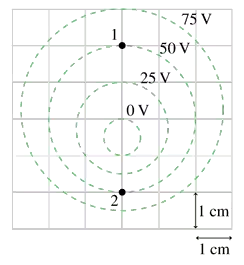
Determine the magnitude and direction of the electric field at points 1 and 2 in FIGURE EX26.9.
Electric field diagram showing points 1 and 2 with voltage levels indicated in concentric circles.

Verified step by step guidance
1
Step 1: Identify the charges and their positions in FIGURE EX26.9. Note the coordinates of the points 1 and 2 where the electric field needs to be calculated.
Step 2: Use Coulomb's law to calculate the electric field due to each charge at point 1. The formula for the electric field due to a point charge is: E=kqr2, where k is the Coulomb constant, q is the charge, and r is the distance from the charge to the point.
Step 3: Determine the direction of the electric field vectors at point 1 due to each charge. Remember that the electric field points away from positive charges and toward negative charges. Use vector components to resolve the electric field into x and y directions.
Step 4: Repeat steps 2 and 3 for point 2, calculating the magnitude and direction of the electric field due to each charge at this location. Again, resolve the electric field into x and y components.
Step 5: Add the electric field vectors from all charges at points 1 and 2 using vector addition. Combine the x and y components to find the resultant electric field's magnitude and direction at each point.

Verified video answer for a similar problem:

This video solution was recommended by our tutors as helpful for the problem above.
Was this helpful?

Key Concepts

Here are the essential concepts you must grasp in order to answer the question correctly.

Electric Field

An electric field is a region around a charged particle where other charged particles experience a force. It is represented by vectors that indicate both the magnitude and direction of the force that a positive test charge would experience. The strength of the electric field (E) is measured in volts per meter (V/m) and can be calculated using the formula E = F/q, where F is the force experienced by the charge and q is the magnitude of the charge.
Recommended video:
Guided course
03:16
Intro to Electric Fields

Superposition Principle

The superposition principle states that the total electric field created by multiple charges is the vector sum of the electric fields produced by each charge individually. This means that when calculating the electric field at a point due to several charges, one must consider the contribution of each charge separately and then combine these contributions, taking into account their directions and magnitudes.
Recommended video:
Guided course
03:32
Superposition of Sinusoidal Wave Functions

Vector Addition

Vector addition is the process of combining two or more vectors to determine a resultant vector. In the context of electric fields, this involves adding the electric field vectors from different sources at a specific point. The direction of the resultant vector is determined by the directions of the individual vectors, and the magnitude is found using the Pythagorean theorem or trigonometric functions if the vectors are not perpendicular.
Recommended video:
Guided course
07:30
Vector Addition By Components