Ch 26: Potential and Field
Knight Calc - Physics for Scientists and Engineers 5th Edition
Knight Calc5th EditionPhysics for Scientists and EngineersISBN: 9780137344796Not the one you use?Change textbook
Chapter 26, Problem 12

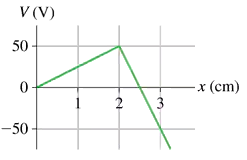
FIGURE EX26.12 is a graph of V versus x. Draw the corresponding graph of Ex versus x.
Graph showing voltage (V) in volts versus position (x) in centimeters, with a peak at 2 cm and a downward trend thereafter.

Verified step by step guidance
1
Step 1: Understand the relationship between electric potential (V) and electric field (E). The electric field is the negative gradient of the electric potential, mathematically expressed as \( E_x = -\frac{dV}{dx} \). This means the electric field is the rate of change of the potential with respect to position.
Step 2: Analyze the graph of \( V \) versus \( x \). Look at the slope of the graph at different points. The slope of the \( V \) graph corresponds to \( \frac{dV}{dx} \), which will determine the value of \( E_x \). If the slope is positive, \( E_x \) will be negative, and if the slope is negative, \( E_x \) will be positive.
Step 3: Identify regions where the slope is zero, positive, or negative. For example, if the \( V \) graph is flat (horizontal), \( \frac{dV}{dx} = 0 \), and \( E_x \) will be zero in that region. If the \( V \) graph is increasing, \( \frac{dV}{dx} > 0 \), and \( E_x \) will be negative. If the \( V \) graph is decreasing, \( \frac{dV}{dx} < 0 \), and \( E_x \) will be positive.
Step 4: Sketch the \( E_x \) versus \( x \) graph based on the slopes of the \( V \) graph. For each region of the \( V \) graph, translate the slope into the corresponding value of \( E_x \). Ensure that the sign of \( E_x \) matches the direction of the slope (negative for increasing \( V \), positive for decreasing \( V \)).
Step 5: Label the axes of the \( E_x \) graph properly. The x-axis remains the same as in the \( V \) graph, while the y-axis now represents \( E_x \). Ensure the graph reflects the correct magnitude and direction of \( E_x \) based on the analysis of the \( V \) graph.

Verified video answer for a similar problem:

This video solution was recommended by our tutors as helpful for the problem above.
Was this helpful?

Key Concepts

Here are the essential concepts you must grasp in order to answer the question correctly.

Electric Field (Ex)

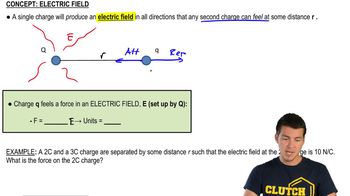
The electric field (Ex) is a vector field that represents the force per unit charge experienced by a positive test charge placed in the field. It is defined as the negative gradient of the electric potential (V), meaning that the electric field points in the direction of decreasing potential. Understanding this relationship is crucial for converting a potential graph into an electric field graph.
Recommended video:
Guided course
03:16
Intro to Electric Fields

Gradient

In physics, the gradient is a mathematical operation that describes the rate and direction of change in a quantity. For a function like electric potential (V), the gradient indicates how steeply the potential changes with respect to position (x). In the context of electric fields, the gradient of V gives the electric field strength and direction, which is essential for accurately drawing the Ex versus x graph.

Graph Interpretation

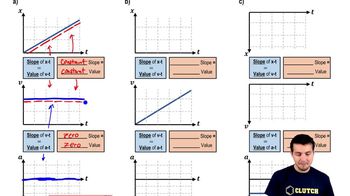
Interpreting graphs involves understanding the relationship between the variables plotted on the axes. In this case, the graph of V versus x provides information about how potential changes with position, which can be translated into the electric field graph. Recognizing features such as slopes and intercepts in the V versus x graph is key to accurately depicting the corresponding Ex versus x graph.
Recommended video:
Guided course
07:32
Graphing Position, Velocity, and Acceleration Graphs