Ch 26: Potential and Field
Knight Calc - Physics for Scientists and Engineers 5th Edition
Knight Calc5th EditionPhysics for Scientists and EngineersISBN: 9780137344796Not the one you use?Change textbook
Chapter 26, Problem 78c

An electric dipole at the origin consists of two charges ±q spaced distance s apart along the y-axis. Assuming s≪x and y, find expressions for Ex and Ey, the components of Ē for a dipole.

Verified step by step guidance
1
Step 1: Begin by understanding the electric dipole setup. The dipole consists of two charges, +q and -q, separated by a distance s along the y-axis. The electric field at a point (x, y) is the vector sum of the fields due to each charge.
Step 2: Write the expression for the electric field due to a single charge. The electric field at a point (x, y) due to a charge q located at (0, s/2) is given by: E = k q / r 2 where r is the distance from the charge to the point (x, y).
Step 3: Approximate the distances to the charges using the assumption s ≪ x and y. For the positive charge at (0, s/2), the distance to the point (x, y) is approximately: r x 2 + y 2 Similarly, for the negative charge at (0, -s/2), the distance is approximately the same.
Step 4: Calculate the components of the electric field. The x-component of the field, Ex, is the sum of the contributions from both charges. Due to symmetry, the y-components of the fields from the two charges will partially cancel, leaving a net Ey component proportional to the dipole moment. Use the dipole approximation formula: E = k ( p ) / r 3 where p = qs is the dipole moment.
Step 5: Combine the results to express Ex and Ey. For Ex, the field is proportional to the dipole moment and inversely proportional to the cube of the distance. For Ey, the field depends on the orientation of the dipole relative to the point (x, y). Use trigonometric relationships to finalize the expressions for Ex and Ey in terms of q, s, x, and y.

Verified video answer for a similar problem:

This video solution was recommended by our tutors as helpful for the problem above.
Video duration:
13m
Was this helpful?

Key Concepts

Here are the essential concepts you must grasp in order to answer the question correctly.

Electric Dipole

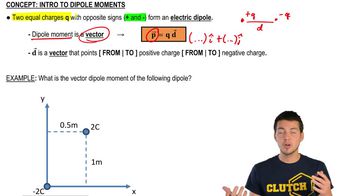
An electric dipole consists of two equal and opposite charges separated by a small distance. It is characterized by its dipole moment, which is a vector quantity pointing from the negative charge to the positive charge. The dipole moment is defined as p = q * d, where q is the charge and d is the separation distance. Understanding the dipole's configuration is crucial for analyzing the electric field it generates.
Recommended video:
Guided course
03:08
Intro To Dipole Moment

Electric Field Components

The electric field (E) produced by a dipole can be expressed in terms of its components along the x and y axes, denoted as Ex and Ey. These components describe how the electric field varies in different directions in space. For a dipole, the electric field components can be derived using the principle of superposition, considering the contributions from both charges at a point in space.
Recommended video:
Guided course
05:23
Balancing a Pendulum in Electric Field

Approximation for s ≪ x and y

The condition s ≪ x and y implies that the distance between the charges (s) is much smaller than the distances from the dipole to the point of interest (x and y). This allows for simplifications in the calculations of the electric field components, as higher-order terms can be neglected. This approximation is essential for deriving the expressions for Ex and Ey in a dipole's electric field.
Recommended video:
Guided course
04:05
Calculating Work As Area Under F-x Graphs