Ch 26: Potential and Field
Knight Calc - Physics for Scientists and Engineers 5th Edition
Knight Calc5th EditionPhysics for Scientists and EngineersISBN: 9780137344796Not the one you use?Change textbook
Chapter 26, Problem 78a

An electric dipole at the origin consists of two charges ±q spaced distance s apart along the y-axis. Find an expression for the potential V(x, y) at an arbitrary point in the xy-plane. Your answer will be in terms of q, s, x, and y.

Verified step by step guidance
1
Step 1: Recall the formula for the electric potential due to a point charge. The potential at a point (x, y) due to a charge q located at a distance r is given by \( V = \frac{q}{4\pi\epsilon_0 r} \), where \( \epsilon_0 \) is the permittivity of free space.
Step 2: Identify the positions of the two charges in the dipole. The positive charge \(+q\) is located at \( (0, s/2) \) and the negative charge \(-q\) is located at \( (0, -s/2) \) along the y-axis.
Step 3: Calculate the distance from each charge to the arbitrary point \( (x, y) \) in the xy-plane. For the positive charge, the distance is \( r_+ = \sqrt{x^2 + (y - s/2)^2} \). For the negative charge, the distance is \( r_- = \sqrt{x^2 + (y + s/2)^2} \).
Step 4: Write the expression for the total potential \( V(x, y) \) at the point \( (x, y) \). The potential is the sum of the contributions from both charges: \( V(x, y) = \frac{q}{4\pi\epsilon_0 r_+} - \frac{q}{4\pi\epsilon_0 r_-} \).
Step 5: Substitute the expressions for \( r_+ \) and \( r_- \) into the formula for \( V(x, y) \). This gives \( V(x, y) = \frac{q}{4\pi\epsilon_0 \sqrt{x^2 + (y - s/2)^2}} - \frac{q}{4\pi\epsilon_0 \sqrt{x^2 + (y + s/2)^2}} \).

Verified video answer for a similar problem:

This video solution was recommended by our tutors as helpful for the problem above.
Video duration:
9m
Was this helpful?

Key Concepts

Here are the essential concepts you must grasp in order to answer the question correctly.

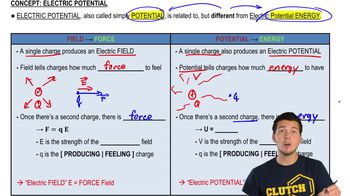
Electric Potential

Electric potential (V) is the amount of electric potential energy per unit charge at a point in space. It is a scalar quantity that indicates the work done to move a positive test charge from infinity to that point against the electric field. The potential due to a point charge is given by V = k * q / r, where k is Coulomb's constant, q is the charge, and r is the distance from the charge.
Recommended video:
Guided course
07:33
Electric Potential

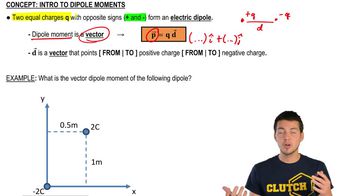
Electric Dipole

An electric dipole consists of two equal and opposite charges separated by a distance. The dipole moment (p) is a vector quantity defined as p = q * d, where q is the charge and d is the separation distance. The potential due to an electric dipole at a point in space depends on the orientation of the dipole and the distance from the dipole, and it can be expressed in terms of the dipole moment.
Recommended video:
Guided course
03:08
Intro To Dipole Moment

Coordinate System in Physics

In physics, a coordinate system is used to define the position of points in space. The Cartesian coordinate system, which uses x, y, and z axes, is commonly employed to describe the location of charges and the resulting electric fields. Understanding how to express the position of points in this system is crucial for calculating electric potentials and fields, especially when dealing with configurations like dipoles.
Recommended video:
Guided course
05:17
Coordinates of Center of Mass of 4 objects