Ch 26: Potential and Field
Knight Calc - Physics for Scientists and Engineers 5th Edition
Knight Calc5th EditionPhysics for Scientists and EngineersISBN: 9780137344796Not the one you use?Change textbook
Chapter 26, Problem 80b

Consider a uniformly charged sphere of radius R and total charge Q. The electric field Eout outside the sphere (r≥R) is simply that of a point charge Q. In Chapter 24, we used Gauss’s law to find that the electric field Ein inside the sphere (r≤R) is radially outward with field strength Ein=14πϵ0QR3rEin=\(\frac{1}{4\pi\epsilon_0}\]\frac{Q}{R^3}\)r. What is the ratio Vcenter/Vsurface?

Verified step by step guidance
1
Step 1: Understand the problem. We are tasked with finding the ratio of the electric potential at the center of a uniformly charged sphere (Vcenter) to the electric potential at its surface (Vsurface). The electric potential is related to the electric field, and we will use the given expressions for the electric field inside and outside the sphere to calculate the potentials.
Step 2: Recall the relationship between electric potential and electric field. The electric potential difference between two points is given by the integral of the electric field along the path connecting those points: V = -∫E·dr. For a radially symmetric field, this simplifies to V = -∫E(r) dr, where E(r) is the radial electric field.
Step 3: Calculate Vsurface. The electric potential at the surface of the sphere (r = R) is determined by integrating the electric field from infinity (where the potential is zero) to the surface. Outside the sphere, the electric field is Eout = (1 / (4πϵ₀)) * (Q / r²). The potential at the surface is: Vsurface = -∫[∞ to R] Eout dr = -∫[∞ to R] ((1 / (4πϵ₀)) * (Q / r²)) dr.
Step 4: Calculate Vcenter. The electric potential at the center of the sphere (r = 0) is determined by integrating the electric field from infinity to the center. This requires splitting the integral into two parts: one for the region outside the sphere (r ≥ R) and one for the region inside the sphere (r ≤ R). Inside the sphere, the electric field is Ein = (1 / (4πϵ₀)) * (Q / R³) * r. The potential at the center is: Vcenter = -∫[∞ to R] Eout dr - ∫[R to 0] Ein dr.
Step 5: Compute the ratio Vcenter / Vsurface. After evaluating the integrals for Vsurface and Vcenter, divide the two results to find the ratio. Simplify the expression to obtain the final ratio in terms of Q, R, and ϵ₀. This step involves algebraic manipulation and substitution of the results from the previous steps.

Verified video answer for a similar problem:

This video solution was recommended by our tutors as helpful for the problem above.
Video duration:
9m
Was this helpful?

Key Concepts

Here are the essential concepts you must grasp in order to answer the question correctly.

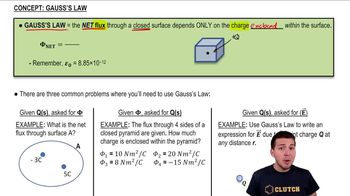
Gauss's Law

Gauss's Law relates the electric flux through a closed surface to the charge enclosed by that surface. It states that the total electric flux is proportional to the enclosed charge, allowing for the calculation of electric fields in symmetric charge distributions. This principle is crucial for determining the electric field both inside and outside a uniformly charged sphere.
Recommended video:

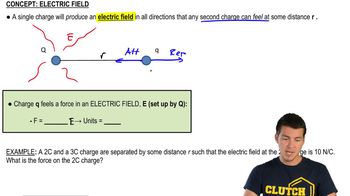
Electric Field

The electric field is a vector field that represents the force exerted by an electric charge on other charges in its vicinity. For a uniformly charged sphere, the electric field outside behaves like that of a point charge, while inside, it varies with distance from the center. Understanding how the electric field behaves in different regions is essential for solving problems related to electric potential.
Recommended video:
Guided course
03:16
Intro to Electric Fields

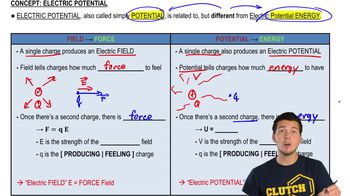
Electric Potential

Electric potential, or voltage, is the work done per unit charge in bringing a charge from infinity to a point in an electric field. It is related to the electric field and can be calculated by integrating the electric field over distance. The ratio of electric potentials at the center and surface of a uniformly charged sphere is important for understanding energy distribution within the sphere.
Recommended video:
Guided course
07:33
Electric Potential