
A 0.25 pg dust particle with 50 excess electrons is sitting at rest on top of a 5.0-cm-diameter metal sphere. Closing a switch charges the sphere almost instantaneously. To what potential must the sphere be charged to launch the dust particle to a height of 5.0 m? Ignore air resistance.
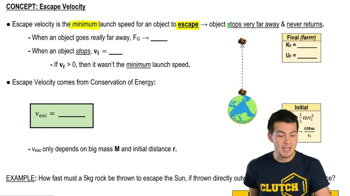
What is the escape speed of an electron launched from the surface of a 1.0-cm-diameter glass sphere that has been charged to 10 nC?
Verified step by step guidance
Verified video answer for a similar problem:
Key Concepts
Escape Velocity
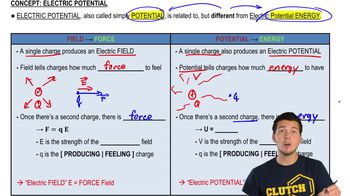
Electric Field and Potential
Coulomb's Law
Three electrons form an equilateral triangle 1.0 nm on each side. A proton is at the center of the triangle. What is the potential energy of this group of charges?
The electric potential in a region of space is given by V=V₀[(x²+2y²)/(0.10 m)²], where V₀ is a constant. A proton released from rest at (x, y)=(20 cm, 0 cm) reaches the origin with a speed of 7.5×10⁵ m/s. At what value of y on the y-axis should a He+ ion (charge +e, mass 4 u) be released from rest to reach the origin with the same speed?
A proton is fired from far away toward the nucleus of an iron atom. Iron is element number 26, and the diameter of the nucleus is 9.0 fm. What initial speed does the proton need to just reach the surface of the nucleus? Assume the nucleus remains at rest.
A room with 3.0-m-high ceilings has a metal plate on the floor with V=0 V and a separate metal plate on the ceiling. A 1.0 g glass ball charged to +4.9 nC is shot straight up at 5.0 m/s. How high does the ball go if the ceiling voltage is +3.0×10⁶ V?
A 2.0-mm-diameter glass bead is positively charged. The potential difference between a point 2.0 mm from the bead and a point 4.0 mm from the bead is 500 V. What is the charge on the bead?
