
Two 10-cm-diameter electrodes 0.50 cm apart form a parallel-plate capacitor. The electrodes are attached by metal wires to the terminals of a 15 V battery. After a long time, the capacitor is disconnected from the battery but is not discharged. What are the charge on each electrode, the electric field strength inside the capacitor, and the potential difference between the electrodes after the original electrodes (not the modified electrodes of part b) are expanded until they are 20 cm in diameter?
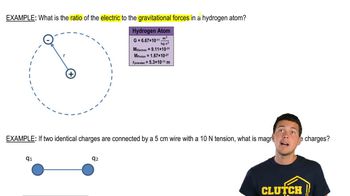
A proton is fired from far away toward the nucleus of an iron atom. Iron is element number 26, and the diameter of the nucleus is 9.0 fm. What initial speed does the proton need to just reach the surface of the nucleus? Assume the nucleus remains at rest.
Verified step by step guidance
Verified video answer for a similar problem:
Key Concepts
Coulomb's Law
Kinetic and Potential Energy
Conservation of Energy
Three electrons form an equilateral triangle 1.0 nm on each side. A proton is at the center of the triangle. What is the potential energy of this group of charges?
A 2.0-cm-diameter copper ring has 5.0×10⁹ excess electrons. A proton is released from rest on the axis of the ring, 5.0 cm from its center. What is the proton's speed as it passes through the center of the ring?
In the form of radioactive decay known as alpha decay, an unstable nucleus emits a helium-atom nucleus, which is called an alpha particle. An alpha particle contains two protons and two neutrons, thus having mass m=4 u and charge q=2e. Suppose a uranium nucleus with 92 protons decays into thorium, with 90 protons, and an alpha particle. The alpha particle is initially at rest at the surface of the thorium nucleus, which is 15 fm in diameter. What is the speed of the alpha particle when it is detected in the laboratory? Assume the thorium nucleus remains at rest.
What is the escape speed of an electron launched from the surface of a 1.0-cm-diameter glass sphere that has been charged to 10 nC?
A 2.0-mm-diameter glass bead is positively charged. The potential difference between a point 2.0 mm from the bead and a point 4.0 mm from the bead is 500 V. What is the charge on the bead?
