
Ch 25: The Electric Potential
Knight Calc - Physics for Scientists and Engineers 5th Edition
Knight Calc5th EditionPhysics for Scientists and EngineersISBN: 9780137344796Not the one you use?Change textbook
Chapter 25, Problem 49

A 0.25 pg dust particle with 50 excess electrons is sitting at rest on top of a 5.0-cm-diameter metal sphere. Closing a switch charges the sphere almost instantaneously. To what potential must the sphere be charged to launch the dust particle to a height of 5.0 m? Ignore air resistance.

Verified step by step guidance
1
Determine the charge of the dust particle using the formula for the charge of excess electrons: \( q = n \cdot e \), where \( n = 50 \) is the number of excess electrons and \( e = 1.6 \times 10^{-19} \; \text{C} \) is the elementary charge.
Calculate the gravitational force acting on the dust particle using \( F_g = m \cdot g \), where \( m = 0.25 \; \text{pg} = 0.25 \times 10^{-12} \; \text{kg} \) (convert picograms to kilograms) and \( g = 9.8 \; \text{m/s}^2 \) is the acceleration due to gravity.
Relate the work done by the electric force to the gravitational potential energy at the height of 5.0 m. Use \( W = q \cdot V \) for the work done by the electric force and \( U = m \cdot g \cdot h \) for the gravitational potential energy, where \( h = 5.0 \; \text{m} \). Set \( W = U \) to find the required potential \( V \).
Account for the geometry of the sphere. The potential \( V \) on the surface of a sphere is given by \( V = \frac{k \cdot Q}{R} \), where \( k = 8.99 \times 10^9 \; \text{N·m}^2/\text{C}^2 \) is Coulomb's constant, \( Q \) is the charge on the sphere, and \( R = 0.025 \; \text{m} \) (convert the diameter to radius in meters). Use this relationship to determine the charge \( Q \) on the sphere.
Combine the results from the previous steps to solve for the required potential \( V \) on the sphere. Ensure all units are consistent and verify the relationships between the electric force, gravitational force, and potential energy.

Verified video answer for a similar problem:

This video solution was recommended by our tutors as helpful for the problem above.
Was this helpful?

Key Concepts

Here are the essential concepts you must grasp in order to answer the question correctly.

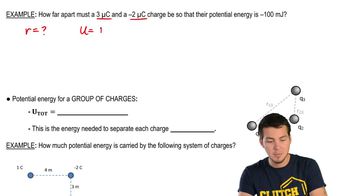
Electric Potential Energy

Electric potential energy is the energy a charged object possesses due to its position in an electric field. It is given by the formula U = qV, where U is the potential energy, q is the charge, and V is the electric potential. In this scenario, the dust particle's excess electrons contribute to its charge, which will be influenced by the electric potential of the charged metal sphere.
Recommended video:
Guided course
07:51
Electric Potential Energy

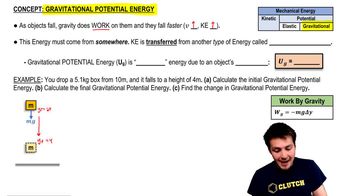
Gravitational Potential Energy

Gravitational potential energy is the energy an object has due to its height above a reference point, typically calculated using the formula U = mgh, where m is mass, g is the acceleration due to gravity, and h is the height. In this problem, the dust particle must gain enough energy to reach a height of 5.0 m, which will be equated to the energy provided by the electric potential of the sphere.
Recommended video:
Guided course
06:35
Gravitational Potential Energy

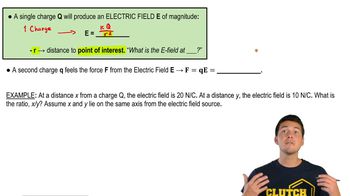
Charge and Electric Field

Charge is a property of matter that causes it to experience a force in an electric field. The electric field created by the charged metal sphere exerts a force on the dust particle, which is influenced by the number of excess electrons it has. The relationship between the electric field (E), potential (V), and distance (d) is crucial for determining the potential needed to launch the particle to the desired height.
Recommended video:
Guided course
06:28
Electric Field due to a Point Charge
Related Practice
Textbook Question

The electron gun in an old TV picture tube accelerates electrons between two parallel plates 1.2 cm apart with a 25 kV potential difference between them. The electrons enter through a small hole in the negative plate, accelerate, then exit through a small hole in the positive plate. Assume that the holes are small enough not to affect the electric field or potential. With what speed does an electron exit the electron gun if its entry speed is close to zero?

1
views
Textbook Question

Three electrons form an equilateral triangle 1.0 nm on each side. A proton is at the center of the triangle. What is the potential energy of this group of charges?

2
views
Textbook Question

The electric potential in a region of space is given by V=V₀[(x²+2y²)/(0.10 m)²], where V₀ is a constant. A proton released from rest at (x, y)=(20 cm, 0 cm) reaches the origin with a speed of 7.5×10⁵ m/s. At what value of y on the y-axis should a He+ ion (charge +e, mass 4 u) be released from rest to reach the origin with the same speed?

1
views
Textbook Question

An arrangement of source charges produces the electric potential V=5000x2 along the x-axis, where V is in volts and x is in meters. What is the maximum speed of a 1.0 g, 10 nC charged particle that moves in this potential with turning points at ±8.0 cm?

1
views
Textbook Question

A room with 3.0-m-high ceilings has a metal plate on the floor with V=0 V and a separate metal plate on the ceiling. A 1.0 g glass ball charged to +4.9 nC is shot straight up at 5.0 m/s. How high does the ball go if the ceiling voltage is +3.0×10⁶ V?

Textbook Question

What is the escape speed of an electron launched from the surface of a 1.0-cm-diameter glass sphere that has been charged to 10 nC?