
An electric dipole consists of 1.0 g spheres charged to ±2.0 nC at the ends of a 10-cm-long massless rod. The dipole rotates on a frictionless pivot at its center. The dipole is held perpendicular to a uniform electric field with field strength 1000 V/m, then released. What is the dipole's angular velocity at the instant it is aligned with the electric field?
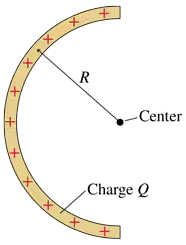
FIGURE P25.72 shows a thin rod with charge Q that has been bent into a semicircle of radius R. Find an expression for the electric potential at the center.

Verified step by step guidance
Verified video answer for a similar problem:
Key Concepts
Electric Potential
Charge Distribution
Integration in Physics
Two metal objects that are in contact must be at the same potential, an assertion we'll prove in the next chapter. Suppose a metal sphere of radius R is charged to 1000 V and a second metal sphere of radius 2R is charged to 2000 V. The two spheres are brought into contact and then separated. Afterward, what is the potential of each sphere?
You are given the equation(s) used to solve a problem. Finish the solution of the problem: (9.0×10⁹Nm2/C2)q₁q₂/0.030m =90×10−6J; q₁+q₂=40nC.
FIGURE P25.67 shows two uniformly charged spheres. What is the potential difference between points 1 and 2? Which point is at the higher potential? Hint: The potential at any point is the superposition of the potentials due to all charges.
FIGURE P25.70 shows a thin rod of length L and charge Q. Find an expression for the electric potential a distance x away from the center of the rod on the axis of the rod.
The wire in FIGURE P25.74 has linear charge density λ. What is the electric potential at the center of the semicircle?
