Ch 25: The Electric Potential
Knight Calc - Physics for Scientists and Engineers 5th Edition
Knight Calc5th EditionPhysics for Scientists and EngineersISBN: 9780137344796Not the one you use?Change textbook
Chapter 25, Problem 78

An electric dipole consists of 1.0 g spheres charged to ±2.0 nC at the ends of a 10-cm-long massless rod. The dipole rotates on a frictionless pivot at its center. The dipole is held perpendicular to a uniform electric field with field strength 1000 V/m, then released. What is the dipole's angular velocity at the instant it is aligned with the electric field?

Verified step by step guidance
1
Calculate the torque acting on the dipole when it is perpendicular to the electric field. The torque (τ) is given by the formula: τ = pE sin(θ), where p is the dipole moment, E is the electric field strength, and θ is the angle between the dipole and the field. Since the dipole is initially perpendicular to the field, sin(θ) = 1.
Determine the dipole moment (p). The dipole moment is defined as p = qd, where q is the charge on each sphere and d is the separation between the charges. Use q = 2.0 nC and d = 10 cm (convert to meters).
Calculate the potential energy difference (ΔU) of the dipole as it rotates from being perpendicular to the field to being aligned with the field. The potential energy of a dipole in an electric field is given by U = -pE cos(θ). Compute ΔU = U_final - U_initial, where U_initial corresponds to θ = 90° and U_final corresponds to θ = 0°.
Apply the principle of conservation of energy. The initial potential energy of the dipole is converted into rotational kinetic energy as it aligns with the field. The rotational kinetic energy is given by KE = (1/2)Iω², where I is the moment of inertia of the dipole and ω is the angular velocity. Set ΔU = KE to solve for ω.
Determine the moment of inertia (I) of the dipole. Since the dipole consists of two spheres of mass m at a distance of d/2 from the pivot, the moment of inertia is I = 2m(d/2)². Use m = 1.0 g (convert to kg) and d = 10 cm (convert to meters). Substitute I into the energy equation to solve for ω.

Verified video answer for a similar problem:

This video solution was recommended by our tutors as helpful for the problem above.
Was this helpful?

Key Concepts

Here are the essential concepts you must grasp in order to answer the question correctly.

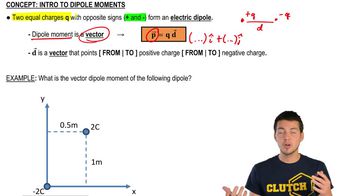
Electric Dipole Moment

The electric dipole moment is a vector quantity that represents the separation of positive and negative charges in a dipole. It is calculated as the product of the charge magnitude and the distance between the charges. In this case, the dipole moment influences how the dipole interacts with an external electric field, determining the torque experienced by the dipole when it is misaligned with the field.
Recommended video:
Guided course
03:08
Intro To Dipole Moment

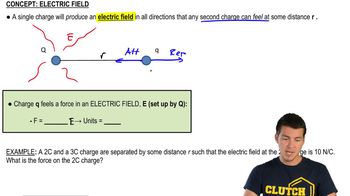
Torque in an Electric Field

When an electric dipole is placed in an electric field, it experiences a torque that tends to align it with the field. The torque ( au) is given by the equation τ = pE sin(θ), where p is the dipole moment, E is the electric field strength, and θ is the angle between the dipole moment and the electric field. This torque causes the dipole to rotate, and understanding this relationship is crucial for determining its angular velocity.
Recommended video:
Guided course
03:16
Intro to Electric Fields

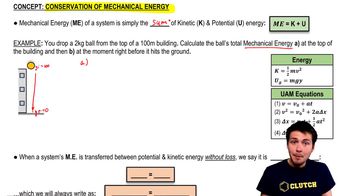
Conservation of Energy

The principle of conservation of energy states that the total energy in a closed system remains constant. In the context of the dipole, the potential energy associated with its orientation in the electric field is converted into kinetic energy as it rotates. By applying this principle, one can relate the initial potential energy of the dipole when perpendicular to the field to its angular velocity when aligned with the field.
Recommended video:
Guided course
06:24
Conservation Of Mechanical Energy