

Ch 25: The Electric Potential
Knight Calc - Physics for Scientists and Engineers 5th Edition
Knight Calc5th EditionPhysics for Scientists and EngineersISBN: 9780137344796Not the one you use?Change textbook
Chapter 25, Problem 70

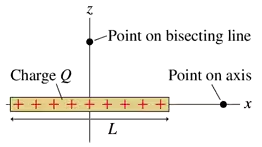
FIGURE P25.70 shows a thin rod of length L and charge Q. Find an expression for the electric potential a distance x away from the center of the rod on the axis of the rod.
Diagram of a charged rod with length L, showing points on the axis and bisecting line for electric potential calculation.

Verified step by step guidance
1
Step 1: Begin by understanding the setup. The rod has a total charge Q distributed uniformly along its length L. We need to find the electric potential at a point located a distance x from the center of the rod along its axis. The electric potential is a scalar quantity, so we can integrate contributions from each infinitesimal charge element along the rod.
Step 2: Divide the rod into infinitesimal charge elements dq. Since the charge is uniformly distributed, the linear charge density λ is given by λ = Q / L. The infinitesimal charge element dq can then be expressed as dq = λ dx', where dx' is a small segment of the rod.
Step 3: The distance from an infinitesimal charge element at position x' on the rod to the point where the potential is being calculated is r = |x - x'|. This distance will vary depending on the position of the charge element along the rod.
Step 4: The electric potential dV due to an infinitesimal charge element dq is given by dV = (1 / (4πϵ₀)) * (dq / r), where ϵ₀ is the permittivity of free space. Substitute dq = λ dx' and r = |x - x'| into this expression.
Step 5: Integrate dV over the length of the rod to find the total potential V. The limits of integration will be from -L/2 to L/2, as the rod is centered at the origin. The integral becomes V = (λ / (4πϵ₀)) ∫[-L/2, L/2] (dx' / |x - x'|). Solve this integral to obtain the final expression for the electric potential.

Verified video answer for a similar problem:

This video solution was recommended by our tutors as helpful for the problem above.
Was this helpful?

Key Concepts

Here are the essential concepts you must grasp in order to answer the question correctly.

Electric Potential

Electric potential is the amount of electric potential energy per unit charge at a point in an electric field. It is a scalar quantity measured in volts (V) and represents the work done to move a unit charge from a reference point to a specific point in the field without any acceleration. Understanding electric potential is crucial for calculating the potential due to charged objects, such as the thin rod in this problem.
Recommended video:
Guided course
07:33
Electric Potential

Linear Charge Density

Linear charge density (λ) is defined as the amount of charge per unit length along a charged object, expressed in coulombs per meter (C/m). For a uniformly charged rod, λ can be calculated by dividing the total charge (Q) by the length (L) of the rod. This concept is essential for determining the contribution of each infinitesimal segment of the rod to the total electric potential at a point along its axis.
Recommended video:
Guided course
8:13
Intro to Density

Integration in Physics

Integration is a mathematical technique used to calculate the total effect of a continuous distribution of quantities, such as charge or mass. In the context of electric potential, integration allows us to sum the contributions of infinitesimal charge elements along the length of the rod to find the total potential at a specific point. This process is fundamental in deriving expressions for electric potential from continuous charge distributions.
Recommended video:
Guided course
11:43
Finding Moment Of Inertia By Integrating