Ch 24: Gauss' Law
Knight Calc - Physics for Scientists and Engineers 5th Edition
Knight Calc5th EditionPhysics for Scientists and EngineersISBN: 9780137344796Not the one you use?Change textbook
Chapter 24, Problem 18

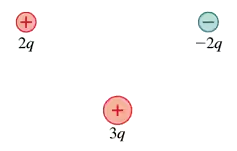
FIGURE EX24.18 shows three charges. Draw these charges on your paper four times. Then draw two-dimensional cross sections of three-dimensional closed surfaces through which the electric flux is (a) 2q/ϵ02q / ϵ_0, (b) q/ϵ0q / ϵ_0, (c) 0, and (d) 5q/ϵ05q / ϵ_0.
Three charges are depicted: two positive charges labeled 2q and 3q, and one negative charge labeled -2q.

Verified step by step guidance
1
Step 1: Recall Gauss's Law, which states that the electric flux (Φ) through a closed surface is given by Φ = Q_enclosed / ϵ₀, where Q_enclosed is the total charge enclosed by the surface and ϵ₀ is the permittivity of free space. This will guide us in determining the flux for each case.
Step 2: For case (a), where the flux is 2q / ϵ₀, identify a closed surface that encloses a total charge of 2q. Draw a surface (e.g., a sphere or cube) that surrounds two of the charges, ensuring the total enclosed charge sums to 2q.
Step 3: For case (b), where the flux is q / ϵ₀, identify a closed surface that encloses a total charge of q. Draw a surface that surrounds only one of the charges, ensuring the total enclosed charge is q.
Step 4: For case (c), where the flux is 0, identify a closed surface that encloses no net charge. This could be a surface that encloses equal positive and negative charges, resulting in a net charge of 0. Draw such a surface.
Step 5: For case (d), where the flux is 5q / ϵ₀, identify a closed surface that encloses a total charge of 5q. Draw a surface that surrounds all three charges, ensuring the total enclosed charge sums to 5q.

Verified video answer for a similar problem:

This video solution was recommended by our tutors as helpful for the problem above.
Video duration:
1m
Was this helpful?

Key Concepts

Here are the essential concepts you must grasp in order to answer the question correctly.

Electric Flux

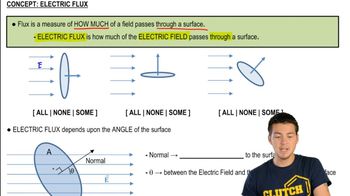
Electric flux is a measure of the electric field passing through a given area. It is mathematically defined as the product of the electric field (E) and the area (A) through which it passes, adjusted for the angle (θ) between the field lines and the normal to the surface: Φ = E · A · cos(θ). The unit of electric flux is the volt-meter (V·m) or equivalently, newton-meter squared per coulomb (N·m²/C).
Recommended video:
Guided course
05:43
Electric Flux

Gauss's Law

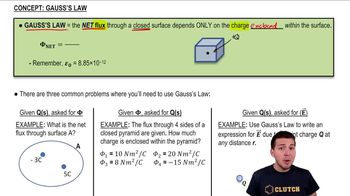
Gauss's Law states that the total electric flux through a closed surface is proportional to the enclosed electric charge. Mathematically, it is expressed as Φ = Q_enc / ε₀, where Q_enc is the total charge enclosed by the surface and ε₀ is the permittivity of free space. This law is fundamental in electrostatics and simplifies the calculation of electric fields for symmetric charge distributions.
Recommended video:

Closed Surfaces in Electrostatics

In electrostatics, a closed surface is an imaginary boundary that completely encloses a volume in space. The choice of this surface is crucial for applying Gauss's Law, as it allows for the determination of the electric field based on the symmetry of the charge distribution. Different configurations of charges will yield different electric flux values through the surface, depending on the amount of charge enclosed.
Recommended video:
Guided course
09:18
Equipotential Surfaces