Ch 24: Gauss' Law
Knight Calc - Physics for Scientists and Engineers 5th Edition
Knight Calc5th EditionPhysics for Scientists and EngineersISBN: 9780137344796Not the one you use?Change textbook
Chapter 24, Problem 14

A 12 cm × 12 cm rectangle lies in the first quadrant of the xy-plane with one corner at the origin. Unit vector n^\(\hat{n}\) points in the +𝒵-direction. What is the electric flux through the rectangle if the electric field is E=(2000m1)xk^E=(2000m^{-1})x\(\hat{k}\) N/C? Hint: Divide the rectangle into narrow strips of width.

Verified step by step guidance
1
Understand the problem: The electric flux (Φ) through a surface is given by the formula Φ = ∫(E · dA), where E is the electric field vector, and dA is the infinitesimal area vector. Here, the electric field is given as E = (2000 m⁻¹)x k̂ N/C, and the rectangle lies in the xy-plane with one corner at the origin. The unit vector n̂ points in the +z-direction, so the area vector dA is perpendicular to the rectangle and points in the +z-direction.
Set up the electric flux formula: Since the electric field is uniform in the z-direction (k̂), and the area vector also points in the z-direction, the dot product simplifies to Φ = ∫(E dA). The electric field magnitude depends on the x-coordinate, so we need to integrate over the area of the rectangle, taking into account the variation of E with x.
Divide the rectangle into narrow strips: The rectangle has dimensions 12 cm × 12 cm (or 0.12 m × 0.12 m). Divide it into narrow vertical strips of width dx, where each strip extends from y = 0 to y = 0.12 m. The area of each strip is dA = (width of strip) × (height of strip) = dx × 0.12 m.
Express the electric flux for a strip: For a strip at a distance x from the origin, the electric field is E = (2000 m⁻¹)x k̂ N/C. The flux through the strip is dΦ = E × dA = (2000 m⁻¹)x × (0.12 m) dx. Integrate this expression over the range of x from 0 to 0.12 m to find the total flux.
Perform the integration: The total flux is Φ = ∫(2000 m⁻¹)x × (0.12 m) dx from x = 0 to x = 0.12 m. Simplify the integral to Φ = (2000 m⁻¹)(0.12 m) ∫x dx from 0 to 0.12 m. Solve the integral ∫x dx = (1/2)x² and evaluate it at the limits x = 0 and x = 0.12 m to find the total flux.

Verified video answer for a similar problem:

This video solution was recommended by our tutors as helpful for the problem above.
Video duration:
3m
Was this helpful?

Key Concepts

Here are the essential concepts you must grasp in order to answer the question correctly.

Electric Flux

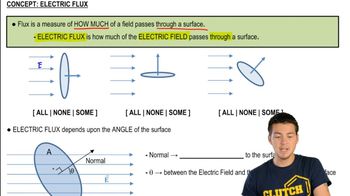
Electric flux is a measure of the quantity of electric field lines passing through a given surface. It is calculated as the dot product of the electric field vector and the area vector of the surface, represented mathematically as Φ = E · A. The unit of electric flux is the volt-meter (V·m) or equivalently, newton-meters squared per coulomb (N·m²/C). Understanding electric flux is essential for analyzing how electric fields interact with surfaces.
Recommended video:
Guided course
05:43
Electric Flux

Area Vector

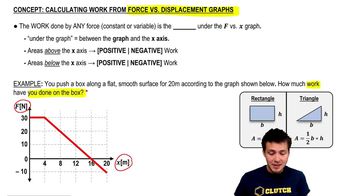
The area vector is a vector that is perpendicular to a surface and has a magnitude equal to the area of that surface. For a flat surface, the direction of the area vector is determined by the right-hand rule, pointing outward from the surface. In this problem, the rectangle lies in the xy-plane, so the area vector points in the +z direction, which is crucial for calculating the electric flux through the rectangle.
Recommended video:
Guided course
04:05
Calculating Work As Area Under F-x Graphs

Electric Field

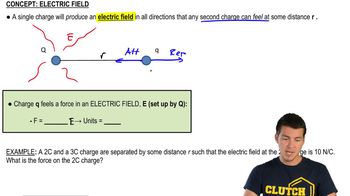
An electric field is a vector field that represents the force exerted by an electric charge on other charges in its vicinity. It is defined as the force per unit charge and is expressed in newtons per coulomb (N/C). In this scenario, the electric field is given as E = (2000 m⁻¹)x k̂ N/C, indicating that the field strength varies with the x-coordinate, which affects how the electric flux is calculated across the rectangle.
Recommended video:
Guided course
03:16
Intro to Electric Fields