Charges and are located at and , respectively. What is the net electric flux through a sphere of radius centered (a) at the origin and (b) at ?
Ch 24: Gauss' Law
Knight Calc5th EditionPhysics for Scientists and EngineersISBN: 9780137344796Not the one you use?Change textbook
Chapter 24, Problem 26
A spark occurs at the tip of a metal needle if the electric field strength exceeds N/C, the field strength at which air breaks down. What is the minimum surface charge density for producing a spark?
Verified step by step guidance1
Understand the relationship between electric field strength and surface charge density. The electric field near the surface of a conductor is related to the surface charge density (σ) by the formula: , where is the permittivity of free space.
Identify the given values in the problem. The electric field strength at which air breaks down is , and the permittivity of free space is a constant: .
Rearrange the formula to solve for surface charge density (σ). Using , multiply both sides by to isolate σ: .
Substitute the known values into the formula. Replace with and with .
Perform the multiplication to find the minimum surface charge density (σ). The result will be in units of , which represents the surface charge density required to produce a spark.

Verified video answer for a similar problem:
This video solution was recommended by our tutors as helpful for the problem above.
Was this helpful?
Key Concepts
Here are the essential concepts you must grasp in order to answer the question correctly.
Electric Field Strength
Electric field strength is a measure of the force per unit charge experienced by a charged particle in an electric field. It is expressed in newtons per coulomb (N/C) and indicates how strong the electric field is at a given point. In this context, the electric field strength of 3.0 x 10⁶ N/C is the threshold at which air becomes ionized, allowing a spark to occur.
Recommended video:
Guided course
Intro to Electric Fields
Surface Charge Density
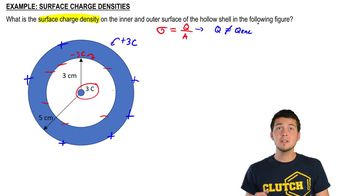
Surface charge density refers to the amount of electric charge per unit area on a surface, typically measured in coulombs per square meter (C/m²). It is crucial for determining how much charge is needed on the needle's surface to create an electric field strong enough to exceed the breakdown threshold of air, leading to a spark.
Recommended video:
Guided course
Surface Charge Density
Breakdown Voltage
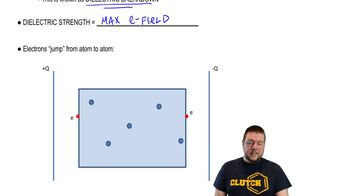
Breakdown voltage is the minimum voltage that causes a portion of an insulator to become electrically conductive. In the case of air, when the electric field strength exceeds 3.0 x 10⁶ N/C, the air molecules become ionized, allowing current to flow and resulting in a spark. Understanding this concept is essential for calculating the necessary surface charge density to achieve this electric field strength.
Recommended video:
Guided course
Dielectric Breakdown
Related Practice
Textbook Question
1
views
Textbook Question
A 10 nC charge is at the center of a 2.0 m x 2.0 m x 2.0 m cube. What is the electric flux through the top surface of the cube?
23
views
Textbook Question
Find the electric fluxes ΦA to ΦE through surfaces A to E in FIGURE P24.29.
1
views
Textbook Question
FIGURE EX24.18 shows three charges. Draw these charges on your paper four times. Then draw two-dimensional cross sections of three-dimensional closed surfaces through which the electric flux is (a) , (b) , (c) 0, and (d) .
Textbook Question
What is the net electric flux through the cylinder of FIGURE EX24.21?
Textbook Question
A thin, horizontal, 10-cm-diameter copper plate is charged to 3.5 nC. If the charge is uniformly distributed on the surface, what are the strength and direction of the electric field 0.1 mm above the center of the top surface of the plate?